Terahertz (THz) radiation consists of electromagnetic waves occupying an electromagnetic spectrum between microwaves and infrared light (frequencies from 0.3 THz to 3 THz). It denotes a boundary of techniques used for generation of the electromagnetic waves. On the one hand THz frequency is too high for a conventional electronics, but on the other hand it is too low to be effectively covered by photonics. More and more THz applications in medicine, spectroscopy, safety and imaging systems have been reported recently despite the lack of efficient THz sources [1]. Therefore, research on compact and scalable THz sources capable to operate at room temperature are carried out. High-electron-mobility transistor (HEMT) with a plasmonic channel of two-dimensional electron gas (2DEG) is a potential candidate to fulfil these requirements [2].
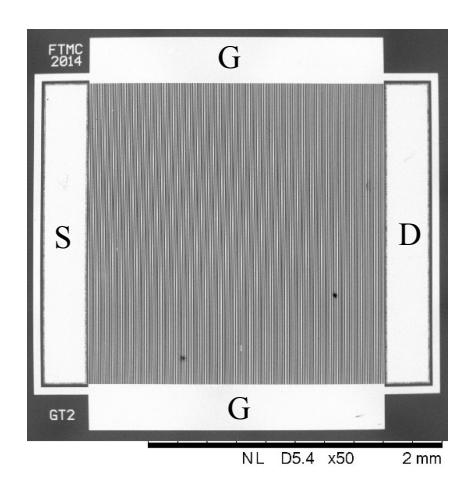
In this work we report on thermally and electrically excited THz emission from AlGaN/GaN HEMTs grown by metalorganic chemical vapour deposition (MOCVD). Electric contacts were formed using optimized photolithography, thin metal film deposition and rapid thermal annealing in N2 ambient (in case of ohmic contacts). The gate contact of the HEMT (Fig. 1) consisted of grating with different period (varying from 200 nm to 7 μm) and width of metal fingers (varying from 120 nm to 4 μm). The grating approach was used to couple out THz radiation via the plasma instabilities in the 2DEG channel [2].
At first the samples were heated by an external heater and the THz emission was measured at fixed temperature. The quantitative analysis of the results was done by comparing the spectra of different samples. In general, Planck's law of black-body radiation was used to describe data in a broad spectrum range. An impact of grating electrode to the THz emission was found by normalizing the radiation spectrum of the plasmonic sample by the data of a bare heterostructure. In addition, it was found that THz radiation of the plasmonic sample was strongly polarized.
In order to observe a weak plasmonic emission, the heating of the sample was reduced by cooling the sample to 112 K with a liquid nitrogen and using a voltage pulses with a duty cycle from 0.5% to 2.5%. At the duty cycle values smaller than 2% (pulse duration less than 1.6 ms) and voltage amplitude set in the range of 60-100 V, the shape of the emission spectrum differed from the black-body radiation of the plasmonic sample, i.e. an intense emission was observed in the frequency range of 150-300 cm-1. The observed emission was attributed to the radiation from ungated 2DEG plasmons. At higher voltage values, the THz emission concerning thermal radiation and electroluminescence of impurities were dominant in the spectrum.