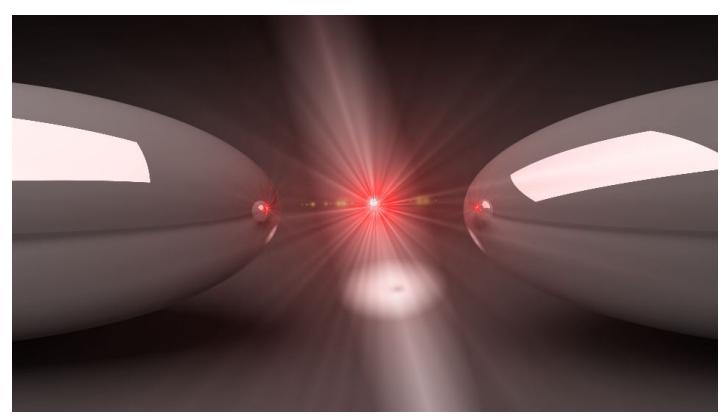
In the last couple of years, technologies based on terahertz radiation have become increasingly interesting due to their numerous applications in fields such as medicine, biotechnology, material engineering and even history of art [1]. For all of these applications, it is essential to use efficient and tunable sources of terahertz frequencies. This presentation is about quantum systems with broken inversion symmetry subject to a strong electric field, which can be used as sources of terahertz radiation.
A two-level quantum system characterized with inversion symmetry and coupled to a classical electromagnetic field undergoes so-called Rabi oscillations where the population flips between the ground and excited levels.
I will discuss how the dynamics is modified if a system of broken inversion symmetry is exploited instead. Then, the eigenstates are characterized with an extra electric dipole moment originating from the polarisation of charges, which plays a significant role. Apart from Rabi oscillations between the energy levels, additional effective oscillations of eigenenergies of these levels can be identified. I will demonstrate how this leads to radiation emission not only at the transition frequency of the system but also with the modified Rabi frequency [2].
The latter could reach the terahertz domain if the quantum system is driven by strong electromagnetic fields, e.g. at close vicinity of plasmonic nanostructures [3]. Final goal is to propose a plasmonic device that could be exploited to implement the above-descibed scenario (Fig. 1).