
GaN is a promising wide band-gap material for fabrication of the solar-blind photo-sensors and radiation tolerant particle detectors applied in high energy physics, radiation monitoring and other fields [1]. Wide band-gap determines low leakage current and proper radiation hardness of devices made of these materials. High luminescence efficiency is an attractive characteristic of GaN. Crystals of large thickness (300-600 μm) and high resistivity (≥106 Ωcm) can also be used for manufacturing of the capacitor type particle sensors with high sensitivity. GaN crystals of such thickness can be synthesised by hydride vapour phase epitaxy (HVPE) and ammono-thermal (AT) techniques. Additionally, acceptor type impurities are often introduced during growth of GaN to reach high resistivity of the material. However, technological defects and impurities introduced during crystal growth affect functional characteristics of devices made of GaN materials. Radiation can also produce damage which determines a degradation of functional parameters of devices. Therefore, it is important to characterise the initial and irradiated material by identifying the existing defects and by evaluating their concentrations in order to produce devices of high quality and to predict their operational characteristics. The spectroscopic methods are highly effective tools for the investigation of technological and radiation defects.
In this work the pristine and reactor neutron irradiated, with different fluences (1012 - 5×1016 cm-2), GaN samples, grown by HVPE and AT techniques have been investigated by electron spin resonance (ESR) spectroscopy technique. The AT GaN samples were initially doped with manganese and magnesium. ESR spectroscopy has been applied for characterisation of defects and impurities introduced during crystal growth and irradiation. Measurements were performed in the temperature range of 100-300 K using Bruker Elexsys E580 spectrometer.
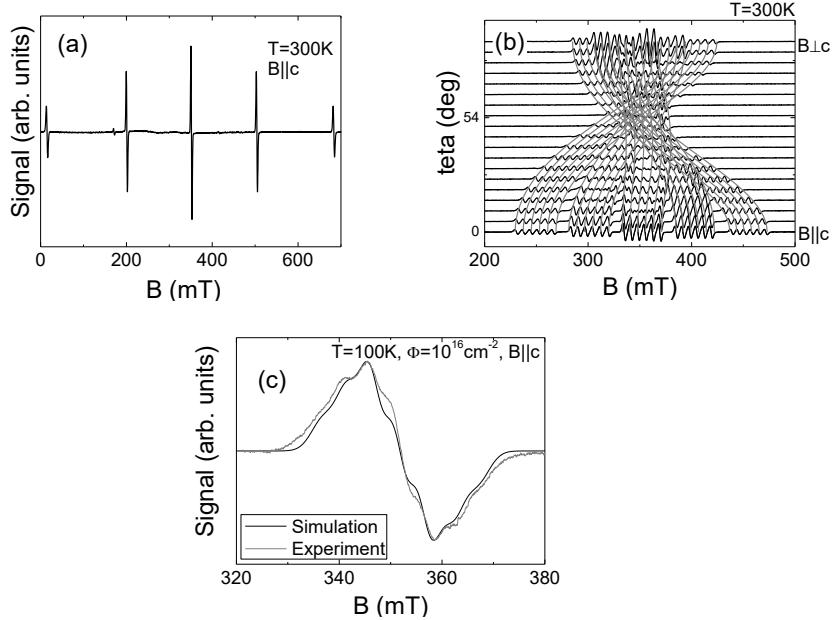
Analysis of ESR spectra measured at different temperatures and microwave power levels, as well as using different magnetic field orientations relative to crystal axis (Fig. 1) allowed us to determine the spin-Hamiltonian parameters of spin system and to identify the dominant spin-active defects and impurities in materials under investigation. The density of defects has been evaluated using Bruker software. In the HVPE grown semi-insulating GaN sample the intentionally introduced Fe3+ impurities of concentration of 2×1017 cm-3 have been detected. The concentration of Mn2+ impurities has been evaluated to be of 1.3×1018 cm-3 in AT GaN sample. After irradiation of AT GaN samples the gallium vacancy and oxygen interstitial atom (VGaON) defect complexes were identified in both the Mn and Mg doped samples. The analysis of the ESR spectra and procedures for identification of spin-active defects and impurities will be discussed.