
Due to its special chemical-physical properties upconverting nanoparticles (UCNPs) can be applied in many fields such as bioimaging and drug delivery. UCNPs demonstrates many useful features such as narrow emission bands, large anti-Stokes shift, resistance to photobleaching, high chemical and physical stability, low chemical toxicity and long luminescence lifetimes. Upconversion of these nanoparticles is affected by the size of the particles as well as the size of its shell. Upconversion efficiency can be enhanced by using various core/shell combinations [1]. The aim of our study was to investigate how upconversion photoluminescence depends on nanoparticles shell, its thickness and the size of the particles.
In this work we investigated hexagonal upconverting nanoparticles with different core size, different shell thickness and different combinations of active and inert shells. Particles that were studied can convert near infrared light to visible light or ultraviolet light (UV) emissions. Photoluminescence emission spectra of the particles were measured by Edinburgh Instruments FLS980 spectrometer. For excitation 980 nm IR laser were used. We studied two groups of particles with different solvents: water and toluene.
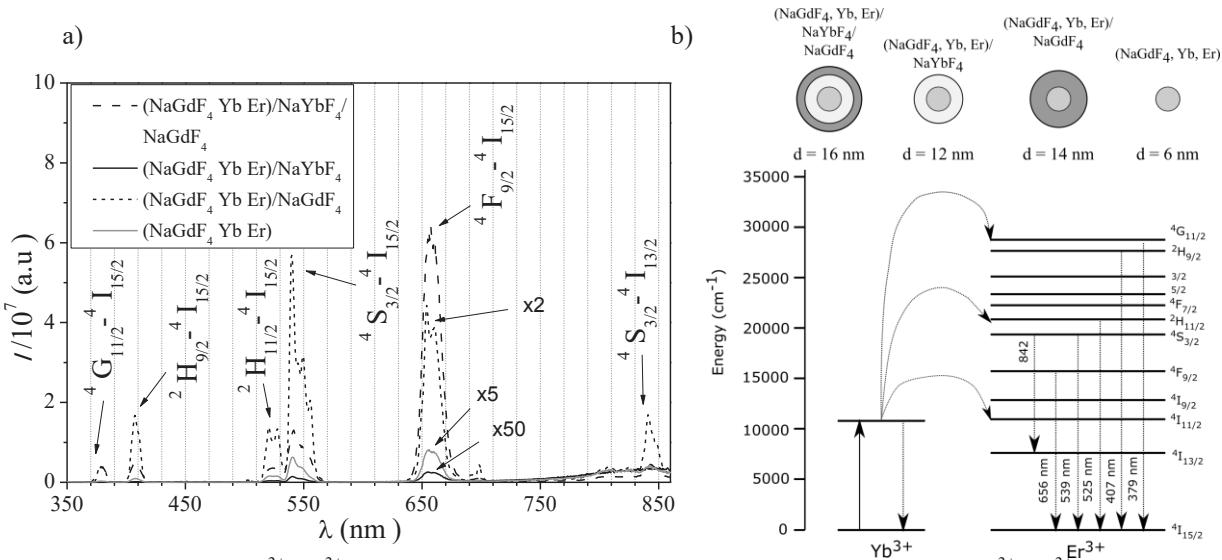
Firstly, upconversion photoluminescence spectra were used to determine differences between photoluminescence intensities of the UCNPs with different shells. These particles were soluble in water. Emission peaks were attributed to the energy transitions of Er3+ ions (Fig. 1). Measurement data shows that upconverting photoluminescence intensity of (NaGdF4:Yb3+,Er3+)/NaYbF4/NaGdF4 is the highest while (NaGdF4:Yb3+,Er3+)/NaYbF4 is the lowest. Reason for this in the case of (NaGdF4: Yb3+,Er3+)/NaYbF4 might be surface defects that appears on the surface of the core due to lattice mismatch [2]. Upconverting photoluminescence emission intensity is highest for (NaGdF4:Yb3+,Er3+)/NaYbF4/NaGdF4. The reason for this is that these particles have active core/active shell/inert shell structure. Active shell of the particle enhances photoluminescence while inert shell protects the particle from surface quenching effects. By using upconversion photoluminescence spectra of the particles that were soluble in toluene, photoluminescence intensity dependence on particle size and shell thickness were determined.
The results obtained show that active and inert shell combinations, shell thickness and core size affects photoluminescence intensity of upconverting nanoparticles.