
Polymer-based composites containing carbon nanostructures are prospective for a wide range of applications such as electromagnetic shielding, next-gen wireless communications, and many others. A few wt% of multi-wall carbon nanotubes (MWCNT) can significantly modify the electromagnetic response of composite increasing its electric conductivity and shielding effectiveness[1, 2, 3]. In the case of epoxy resin there is less than 0.25 % of MWCNT needed to create percolation network, but due to the nanotubes strong agglomeration ability, a significant amount of nanotubes is excluded from percolation network. To reduce the number of agglomerates NH2-radicalization was used[4]. The dispersion of radicalized MWCNT in the epoxy resin is more homogeneous due to amino radicals taking part in epoxy resin curing.
The permittivity of composite MWCNT-NH2 composites was measured in the range up to 10 MHz. For modeling such a composite system simple 2D-circuit consists of resistors, capacitors, diodes (constant phase elements), i.e. RCD-model[5] was used. In this case, resistors correspond to metallic nanotubes, capacitors to polymer matrix (epoxy resin) and diodes to contacts between nanotubes.
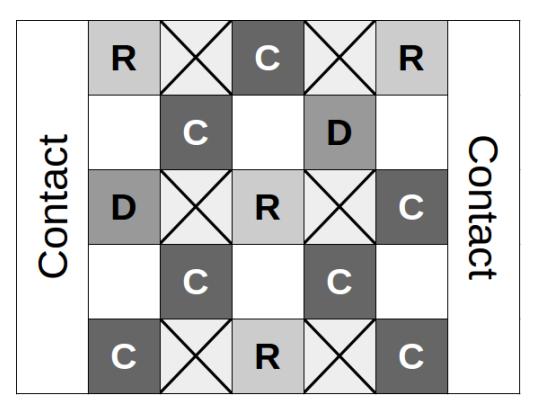
The result of modeling with random circuit method strongly depends on network properties. To obtain realistic results the circuit must provide at least one connection between the left and right sides consisting of only resistors and capacitors. It corresponds to percolation network in the real composite. Additionally, there must be an alternative connection containing only capacitors because more than 98 % of the composite is the dielectric matrix.
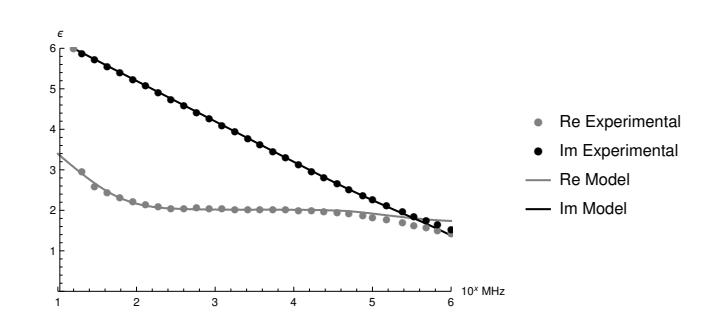
Results of modeling using equivalent RCD network are shown in Fig. 2. They are in good agreement with experimental data. The model gives better fitting for samples with bigger MWCNT concentrations. The permittivity of samples with MWCNT-NH2 concentrations larger than 0.5 % can be successfully approximated, but for lower concentrations in the experimental setup, the model does not reproduce experimental data. That means that for low concentrations close to percolation threshold the RCD-model needs to be modified. There exist also other possibilities to fit experimental data, e.g. variation of relative R, C, D concentrations; introducing of any dispersion of diodes by the scale parameter C1 and exponent k; it is also possible to present statistic data and to model R-C-D network by different morphology (i.e. the network consisting of not square but triangle hexagonal parts). Hereinafter our future efforts will be focused on the experimental verification and improvement of described here methodology using above strategies.