
The functional ferromagnetic shape memory materials attract an increasing attention of researchers due to their unusual deformation behavior resulting in a reversible size change under the influence of temperature, applied external stresses, magnetic fields, and their combination, demonstrating the shape memory effect (SME), pseudoelasticity or superelasticity (SE), plasticity of transformation, magnetoelastic deformation, etc. The above mentioned properties have found various practical applications as actuators in robotics, automotive, aerospace and biomedical industries.
The phenomenon of pseudoelasticity consists in an ability of the material to restore its original shape after a plastic deformation that significantly exceeds elastic one. Mainly, copper (Cu-Al-Ni, Cu-Zn-Al, etc.) and nickel based (NiTi) pseudoelastic functional materials were studied and found practical applications. The investigation of deformations induced by external stresses was also carried out for ferromagnetic iron-based alloys, among which Fe-Pd, Fe-Pt and Fe-Ni-Co-Ti are of the greatest interest.
This research is devoted to the study of mechanical behavior of ferromagnetic Fe-Ni-Co-Ti alloy, previously subjected to different regimes of thermomechanical treatment consisting of: quenching in water followed by multiple rolling with different compression degrees and aging. The search for optimal regimes of cold deformation and subsequent aging to obtain a maximum level of pseudoelasticity in polycrystalline ferromagnetic Fe-Ni-Co-Ti alloy was carried out in this work. The measurement of microhardness, low-field magnetic susceptibility, resistivity, mechanical characteristics of alloy in austenitic and martensitic phases was carried out in the work.
The conditions which change the kinetics of martensitic transformation (MT) from nonthermoelastic to thermoelastic and lead to a significant strengthening of austenite at aging when nanoparticles of $γ'$-phase (CoNi)3Ti precipitate arise. It was established experimentally that introduction of a new operation, namely, the cold deformation before the aging of quenched austenite, substantially affects the mechanical properties of Fe-Ni-Co-Ti alloy austenite and martensite, as well as characteristics of the magnetic and martensite transformations. With increase of plastic deformation degree, all of the mentioned parameters vary nonmonotonically.
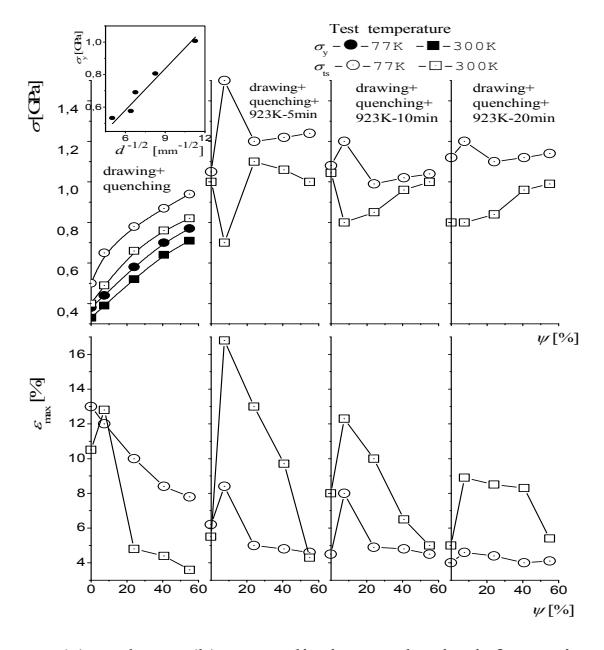
The experimentally determined dependences (fig. 1) of ultimate tensile strength $σ_{ts}(ψ)$ show that with the increase of $ψ$, the strong strain hardening of austenite occurs while the strain before break ($ε_{ts}$) decreases in 1.5÷2 times. At the same time for the martensite phase, the decrease of strain hardening is observed while $ε_{ts}$ decreases in 2÷4 times. It is found that preliminary plastic deformation of quenched austenite of the ferromagnetic Fe-Ni-Co-Ti shape memory alloy and subsequent aging favours the increase of reversible pseudoelastic deformation.