
For conventional fiber chirped pulse amplification (FCPA) systems a mode-locked femtosecond laser oscillator is required [1]. Strong normal dispersion of silica glass at wavelength around 1μm limits pulse duration Yb doped fiber oscillators. Passively mode-locked fiber oscillators may be operated in the anomalous dispersion regime if dispersion compensators are introduced in the cavity [2]. The implementation of a chirped fiber Bragg grating (CFBG) as anomalous dispersion source in the cavity was demonstrated [3]. The main advantage of CFBG dispersion control in comparison with bulk optical components such as prisms or diffraction gratings is that it is realized all-in-fiber principle. Moreover chirp and reflection profile of CFBG can be specially selected to achieve solitary pulse formation.
Another important characteristics for seed pulses for FCPA are chirp profile, spectrum smoothness and temporal shape. Seed pulses must be either transform limited or have a linear chirp, which allows compression without pulse distortions. Also, spectrum of the seed pulses must be smooth, as any ripples in the spectrum will be transformed in the ripples of the temporal envelope when pulses are stretched [4]. These temporal ripples will be enhanced in nonlinear fiber amplifier [4]. Finally, temporal shape of the seed pulses also plays a role in FCPA systems. Due to accumulated nonlinear phase, conventionally defined as B integral, recompressed pulses possess side-pulse structure, due to which decreases peak power and reduces pulse contrast. This effect can be minimized by use of parabolically shaped pulses [5].
In this work we present experimental implementation of femtosecond fiber oscillator which utilizes an anomalous dispersion CFBG for dispersion control and spectral filtering. Also we demonstrate generation of parabolically shaped pulses in normal dispersion by doped fiber amplifier using this femtosecond oscillator.
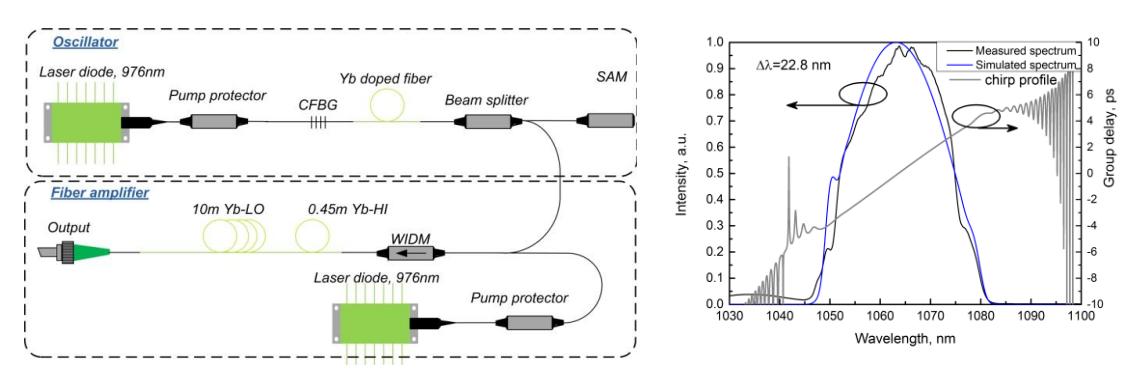
Linear cavity geometry consisting of CFBG, polarization maintaining single mode Yb doped fiber, beam splitter and saturable absorber mirror (SESAM) was used to generate ultra-short pulses. In stable self-starting single pulse mode-locking regime oscillator emits nearly bandwidth-limited pulses with duration of 380 fs and 15 pJ energy at a repetition rate of 32 MHz at 1064 nm central wavelength. Pulses from the oscillator were amplified in polarization maintaining fiber amplifier that consisted of two gain fibers with different Yb concentration (Yb-LO, Yb-HI). Oscillator pulses due to cumulative action of amplification, nonlinearity and dispersion when propagating in Yb-LO fiber were parabolic shaped. After fiber amplifier, the output pulses had energy of 1.4 nJ, duration of 6.5 ps and the spectral bandwidth of 22.8 nm. The shape of the spectrum (Fig. 1, right) was close to parabolic with typical steep edges. More detailed experimental and simulation results will be presented on a conference.