
Detection of cations is of great importance to many scientist such as biologist, chemists and environmentalist. Fluorescent and colorimetric chemosensors receive much attention because of their advantages: high selectivity and sensitivity, cheap equipment, rapid response, nondestructive methodology and direct visual perception [1].
1,8-Naphthalimide derivatives are widely used for various applications such as anticancer agents, analgesics in medicine, fluorescent markers in biology, fluorescence switchers and sensors, etc. [2] Derivatives of 1,8-naphthalimide compounds generally have high electron affinity due to the existence of an electron-deficient center and can be easily functionalized. Meanwhile dimethylaniline (DMA) moieties are famous for they unusual dual fluorescence [3].
In this work we investigated photophysical sensing properties of 1-8-naphthalimide and dimethylaniline donor-aceptor compounds in different polarity and pH mediums as well as in aquas solutions. The naphthalimide derivatives were synthesized by D. Gudeika from prof. J. V. Gražulevičius group at Kaunas University of Technology (KTU).
The solvatochromic investigation of absorption and fluorescence spectra in medium of various polarity (0–3.96D) approved a formation of charge transfer states. The color of fluorescence varies in the visible range of spectrum from 470 nm in non-polar solvent to 770 nm in the most polar solvent while the quantum yield is quenched from 82% to 0.3% respectively. Thus the molecules can be applied as polarity probe.
Investigation of metal ion sensing revealed that twisted internal charge transfer can be turned off on all molecules by adding of mercury(II) or iron(II) ions which leads to drastic changes in absorption and fluorescence spectra. Emmision enchantment of more than 1000 times is observed while ICT fluorescence is quenched up to 10 times. Moreover, naked eye visible color changes are seen under daylight or UV-light upon addition of Hg2+ or Fe2+, thus the molecules can be easily used as fluorescnce probe for mercury(II) and iron(II) detection. The described detection of metal ions works in all tested organic solvents except non polar dimethyl-sulfoxide (DMSO) in which no absorbance or fluorescence changes are observed. The strongest photophysical effect due to metal ions is noticed in acetone solvent, which, in low concentrations, is not harmful to cells.
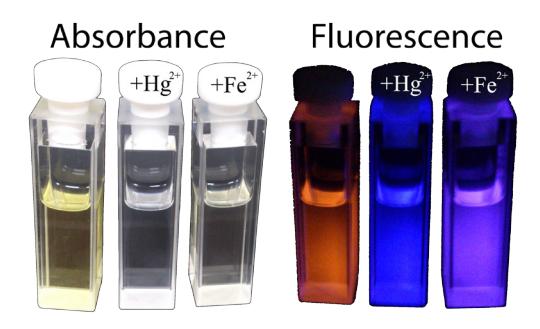
4-(4-dimethylaminophenyl)-N-(2-(2-hydroxyethoxy)ethyl)-1,8-naphthalimide shows absorption response to Hg2+ in aqueous solution of acetonitrile/water (30%:70%, v/v) thus can be used as a colorimetric sensor for detection of mercury(II) ions in living organisms.