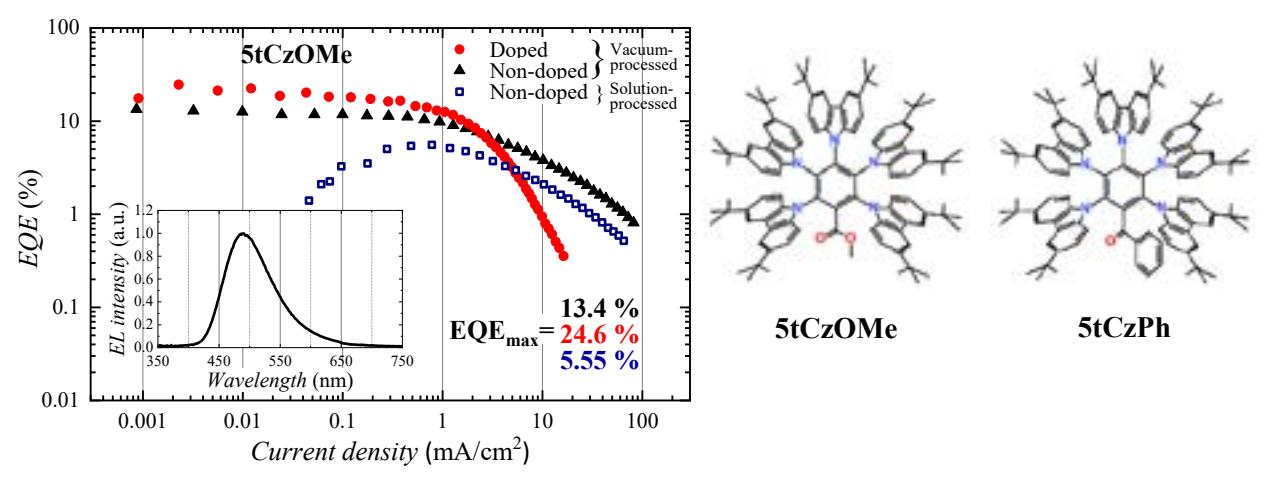
Thermally activated delayed fluorescent (TADF) emitters attracted great interest due to the ability to harvests all the triplet excitons via reverse intersystem crossing process into the singlet manifold thereby ensuring 100% internal quantum efficiency [1]. TADF emitters based on pentacarbazolyl-benzene were recently reported to demonstrate high efficiencies and stabilities in a blue-emitting OLED [2]. In this work, we report on new sky-blue-emitting pentacarbazolyl-substituted benzene derivatives as TADF emitters (Fig. 1) featuring phenyl ketone acceptors and sterically shielding tert-butyl groups for reduced concentration quenching as well as for better processability.
The emitters exhibited up to 50%, 60% and 80% fluorescence quantum yields in toluene solution, neat film and DPEPO host (doped at 20 wt%), respectively. Owing to deep emitter HOMO (Highest Occupied Molecular Orbital) level (-5.9 eV) and high triplet exciton energy (2.9 eV) OLEDs were fabricated using CzSi and DPEPO exciton blocking layers on different sides of the emissive layer [3]. Vacuum-processed OLEDs with doped emissive layer exhibited up to 24.6% external quantum efficiency (EQE), very high luminous efficacy and power efficiency of 121 cd/A and 100 lm/W, respectively, at the turn on voltage of 3.8 V (Fig. 1). Even though vacuum- and solution-processed non-doped OLEDs expressed lower EQE, they demonstrated severely reduced efficiency roll-off. These results indicate that new pentacarbazolyl-substituted benzene TADF emitters are promising for the application in OLED displays and solid-state lighting.