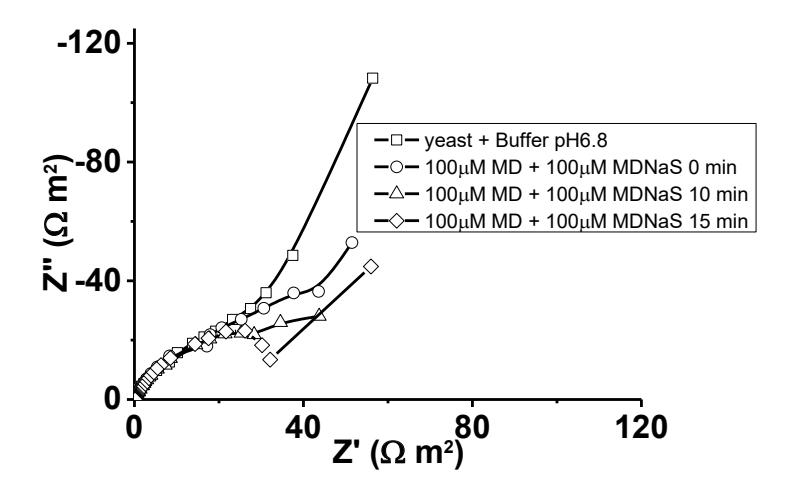
Electrochemical impedance spectroscopy (EIS) is widely used in various bioelectrochemical researches. Conventional EIS techniques gives only average response of the whole system. In order to observe localized EIS, the working electrode has to be moved in close to the surface of interest. In this case, scanning electrochemical microscopy (SECM) [1] and EIS could be merged, and this system is called scanning electrochemical impedance microscopy (SEIM). However, measurements by this technique are complicated due to very long experiment time, for example, in the 1mHz-100kHz frequency range measurement of EIS at one point will take 20 min. To take care of this problem, SECM can be combined with Fast Fourier transformation (FFT) electrochemical impedance technique, which measures electrochemical impedance in early mentioned range of frequencies in seconds. Thus, we have three techniques for the EIS measurements, each of them has its own advantages/disadvantages. The idea of our research was to compare these three techniques in order to find out the differences of results when biological samples are investigated. We choose yeast Saccaromyces cerevisiae [2], diluted in suspension (non-immobilized) [3]. We used two redox mediators-based system, one of them was lipophilic redox mediator 2-Methyl-1,4-naphthoquinone (Menadione), and another - hydrophilic mediator sodium 1,4-naphthoquinone-2-sulfonate. We measured EIS with all three techniques. It was found that the response depends on time, therefore, EIS-FFT technique in living cells investigation is a very promising candidate (Fig. 1). On the other hand, the yeast reaches steady-state after some time. Therefore, conventional EIS has the same advantage then one is interested in the final result of processes, occurred in the cells. Using SEIM, the volume of solution is small, and working electrode is ultramicroelectrode (UME), thus, the steady-state current on UME can be achieved very fast. This tool could be used to detect yeasts redox activity in industry using small volumes of yeast suspensions.