Magnetic materials overall are a very useful class of materials that have been used in many applications affecting our everyday lives. Nanoporous, magnetic materials in particular are of interest in areas such as spintronics where surface and interface effects are hugely important. Traditionally in devices, magnetism has been controlled by the use of external magnetic fields created by passing current through a conducting wire. However, as devices become smaller, resistive heating in the conducting wire (or Joule heating) has led to much lower energy efficiencies. Therefore, there has been a significant research effort to control micro- and nano-scale magnetic materials directly with electric fields, thereby minimizing the electric currents involved. 1 A number of mechanisms for controlling magnetism with applied voltage have been investigated including direct voltage application, multiferroic coupling, and cation intercalation. Recently, another mechanism has been popularized called the magneto-ionic effect ion which ionic migration (often of oxygen anions) is used to induce changes in magnetism.2
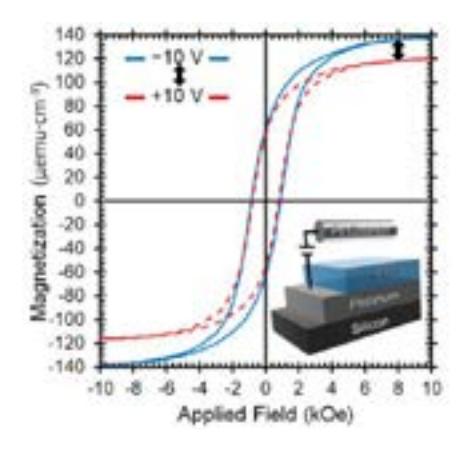
Here we present the synthesis of nanoporous cobalt ferrite (CoFe2O4, CFO) and demonstrate magnetoionically-controlled, reversible changes in its magnetic properties. Thin films of CFO are prepared using sol-gel chemistry and made nanoporous by introducing a sacrificial block copolymer templating agent. The films are deposited via dip coating onto a Pt-coated Si and then annealed to crystallize the CFO and remove the polymer template. The final porous films are then assembled into an electrochemical cell with a Pt wire counter electrode and a propylene carbonate-based liquid electrolyte. By applying a negative voltage, the cobalt ferrite becomes partially reduced, leading to an increase in saturation magnetization of 15% ($M_S$) and a reduction in coercivity ($H_C$) as high as 28%, depending on the voltage applied (from -10 V to -50 V). Upon removal of the negative voltage, the effects are found to largely remain (e.g., after removal of -10 V, $M_S$ remains 12% higher than in the pristine sample). Interestingly, with the application of a positive voltage, all changes can be completely reversed and thus the initial properties are recovered. The samples were characterized by SEM, XRD, XPS and magnetometry in order to better understand the underlying mechanism which we determine is the magneto-ionic effect where oxygen ions migrate in and out of the CFO in respond to the applied electric field.