
Metalloporphyrins are widely used chromophores, which possess unique absorption properties. In strong supramolecular complexes between achiral metalloporphyrin as a host and chiral substrate as a guest chirality transfer occurs. It is also known, that in chlorinated solvents like chloroform and dichloromethane porphyrins bind strongly primary amines. [1] The cooperation of experimental facilities for measuring optical spectra and performing quantum-chemical calculations allows to get reliable information about the mechanism of chirogenesis.
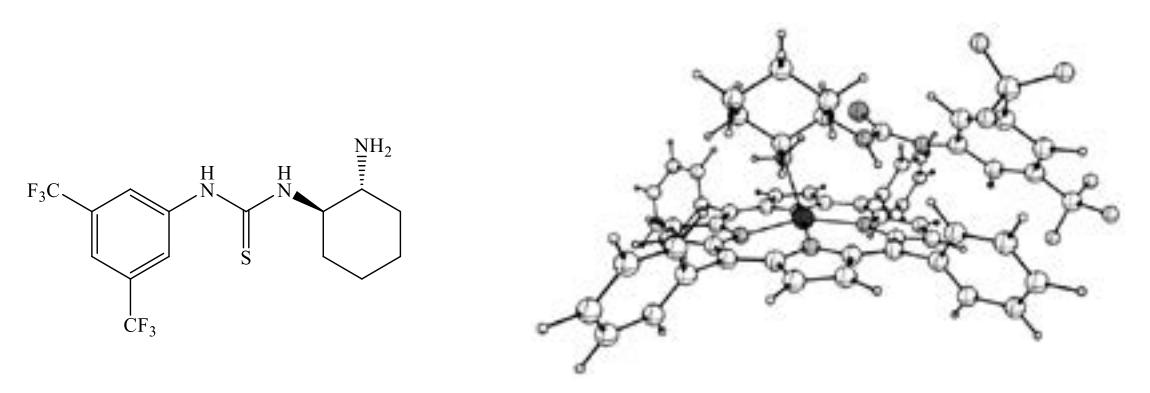
In this work we present comprehensive experimental and computational study of host-guest supramolecular interactions of Takemoto organocatalyst [2] and zinc porphyrins complexes (Fig. 1). For the determination of the strength of the intermolecular binding between host and guest UV/Vis titration method was used. For monitoring the chirality transfer CD spectroscopy was applied. High level quantum-chemical calculations were performed in the framework of DFT and TDDFT approximations.
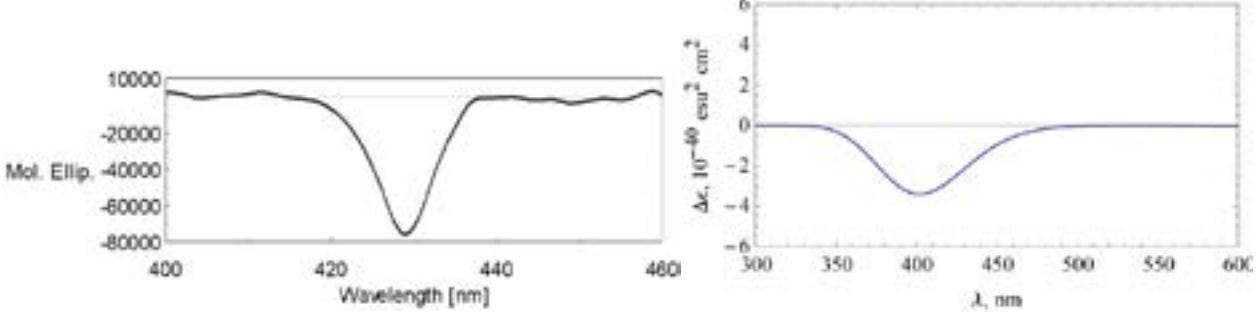
UV titrations showed that achiral hosts, zinc porphyrins, and chiral guest Takemoto organocatalyst form supramolecular complexes. Furthermore, in the complexes due to the strong binding a chirality induction was observed using CD spectroscopy. All this has been supported by extensive computational studies, which included conformation analysis, geometry optimisation, UV/Vis and CD spectra calculations in solvent (Fig. 2).
The results of the work could be applied in asymmetric catalysis and chirality sensors, which are based on combination of metal catalysis, organocatalysis, supramolecular chemistry and computational design.