In 2006 RoHS directive was accepted in European Union. It declared the need to diminish the use of lead-containing materials in electronic components due to harmful effects on health and environment. Therefore, the need to search for new lead-free compounds appeared. Options for such materials can be $BaTiO_3$ (BT) or Bi based perovskites such as $Bi(Mg_{1/2}Ti_{1/2})O_3$ (BMT), $BiScO_3$ and $BiFeO_3$ (BF). These compounds have high Curie temperature and simple $ABO_3$ perovskite structure. [1] Based on the requirements of RoHS and the mentioned properties of these materials measurements of dielectric properties of lead-free $BaTiO_3$-$Bi(Mg_{1/2}Ti_{1/2})O_3$-$BiFeO_3$ ceramic were carried out.
BT BMT BF samples were polished down. Then contacts were applied with silver pasta on both surfaces. Later samples were calcined at 300K-573K temperature range on heating at 2 K/min rate. Dielectric measurements were made in 130-500K temperature range and 20 Hz – 1 GHz frequency range on cooling at 1 K/min rate. Measurements from 20 Hz to 1 MHz were made with LCR meter HP-4284A. With this device capacity and loss tangent were measured. From 10 MHz to 1 GHz measurements were made using vector analyzer Agilent 8714ET in coaxial line. Ferroelectric properties were measured using analyzer AixaCCt TF 2000.
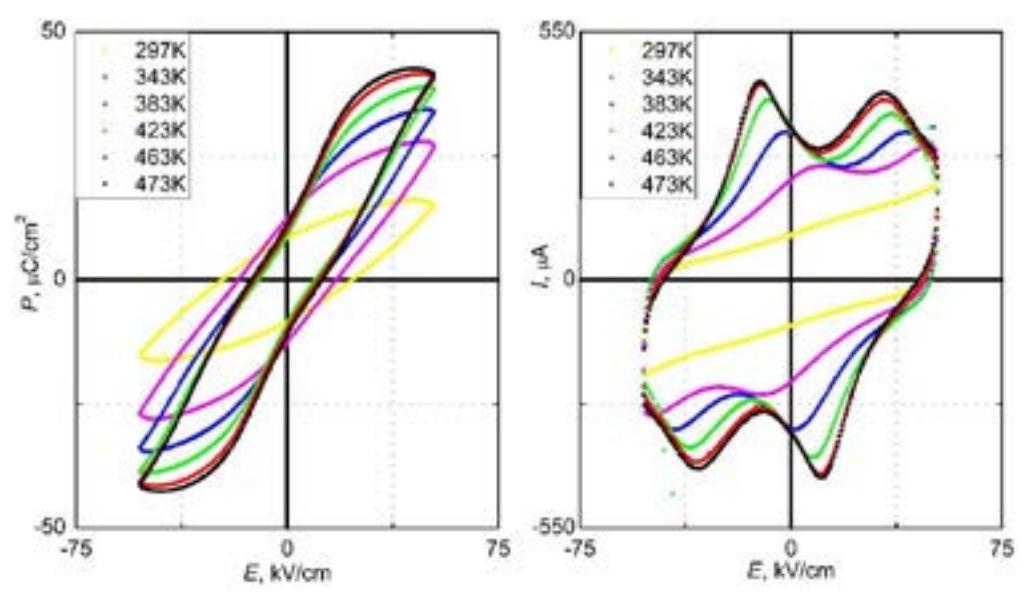
Fig 1 shows polarization and current dependence of electric field. Graph on the left shows measured hysteresis loops, which explain that compound is ferroelectric. On the right graph watching two peaks of current. The wider may be related to the polarization switch. The other can be related to back switching, which can be explain by bismuth ferrite or bismuth magnesium titanate defects. Domain wall can hook up to defect and in material appears stress, which turns domain wall in previous position.