
Coastal upwelling, a phenomenon found in large stratified lakes, estuaries, and oceans [1] is an important process for ecologically sensitive regions of the global ocean, like the Baltic Sea. During the warm season (April-September) northerly winds are known to trigger intense occurrences of coastal upwellings in the SE Baltic Sea coast. Typically, there are about 4 upwelling events taking place per warm season each year in the study region, but their total duration might represent up to 30% of the warm season. Wind-induced coastal upwelling is an important dynamical feature in the Baltic Sea region: it significantly changes hydro-meteorological conditions and ecosystem functioning in the SE Baltic Sea coastal zone and during rapid inflows to the Curonian Lagoon may strongly influence its environment.
In this study, we analyse the impact of coastal upwelling events on the sea surface temperature (SST) and chlorophyll-a (chl-a) concentration in the SE Baltic Sea and the Curonian Lagoon. Satellite Terra/Aqua Moderate Imaging Spectroradiometer (MODIS) SST maps for the period of 2000-2015 were used to characterize the coastal upwelling from the distribution and evolution of its surface thermal signatures. Spatial variability of chl-a induced by upwelling was assessed using MERIS/Envisat (Medium Resolution Imaging Spectrometer on board of Envisat satellite, European Space Agency) maps. For the estimation of chl-a concentration FUB processor (1.2.4 version, plug-in in BEAM/VISAT software) was applied in the coastal waters, as described and validated in [2]. In the Curonian Lagoon chl-a was estimated by semi-empirical band ratio algorithm applied to images after atmospheric correction with the 6SV. The algorithm is based on band ratio of the red and near-infrared spectral regions [3].
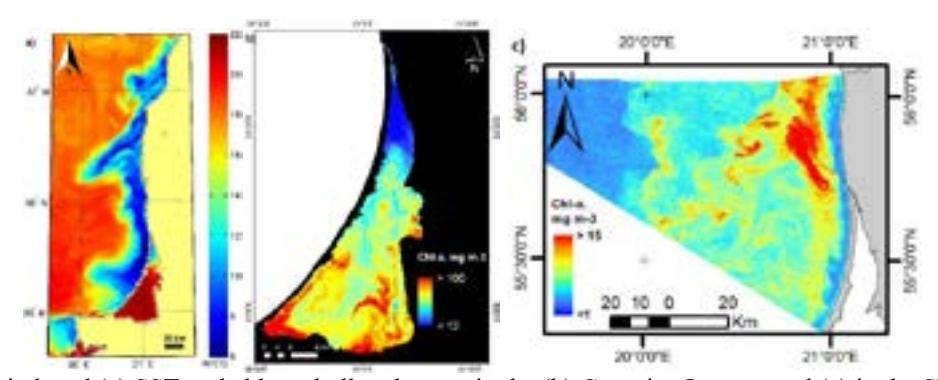
Altogether, during April-September 2000 – 2015, 69 coastal upwelling events were registered in MODIS data from which 18 events had an influence to the pelagic environment of the Curonian Lagoon due to sea-lagoon interaction through the narrow Klaipeda Strait. A detailed analysis of coastal upwelling development, its main oceanographic characteristics together with an impact on the Curonian Lagoon and the coastal environment are presented.
We show that during extreme events cold upwelled waters with SST drop up to 15 °C are extending offshore in the form of transverse filaments of about 70 km in length (Fig. 1a). Our research evidently shows that coastal upwelling events has significant impact on the chl-a concentration changes in both the Curonian Lagoon (Fig. 1b) and the coastal area of the SE Baltic Sea (Fig. 1c).