
Electromagnetic surface waves have been used for various optical sensing such as protein interaction determination [1] or gas adsorption [2]. Depending on a structure of a sample, different surface waves can be generated. At a metal dielectric boundary a surface plasmon-polariton (SPP) wave can appear while a Bloch surface wave (BSW) can be generated on a periodic dielectric structure with semi-infinite dielectric media.
Bloch surface waves are confined on the photonic crystal surface and surrounding material interface [3]. Due to low losses in the dielectrics the BSW can propagate long distances. Another advantage of BSW is that it can be excited in both TE and TM polarization modes, thus it allows us to investigate changes of polarization states if measuring technique allows us to do so. To determine these polarization states and phase changes, we use spectroscopic ellipsometry measuring technique. In order to excite BSW a glass prism as a coupler to achieve conditions of total internal reflection (TIR) is commonly used. Ellipsometer configuration with prism coupler shown in Fig. 1 is called total internal reflection ellipsometry (TIRE). High sensitivity to changes of the polarization in TIRE method allows us to analyze small alterations in structure of a sample. Thus, depending on materials used and their periodicity, BSW shift can be measured. It is important to highlight that due to low energy losses in dielectrics, BSW has a narrow half-width dip in amplitude (${\Psi}$ ellipsometric parameter) and in some cases even almost disappear, meanwhile changes in ellipsometric parameter ${\Delta}$ are always presented due to interference effect of the BSW. The sensitivity features of ellipsometric parameter ${\Delta}$ for angles larger than the critical angle is the main advantage of TIRE method over the standard ellipsometry and intensity measurements.
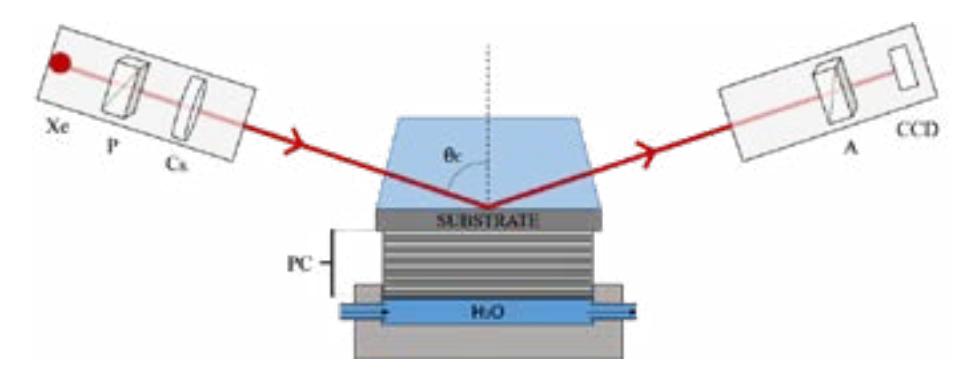
In this study TIRE were carried out on a one dimensional photonic crystal (1D PC) in order to analyze optical response of such structures. PC was made of 6 pairs of periodic layers of TiO2 (~60 nm) and SiO2 (~110 nm) was used as a sample. For TIRE configuration a 70° prism and J. A. Woolam M-2000X ellipsometer were used. TIRE measurements were conducted cuvette filled with liquids with different refractive index dispersion in order to analyze the sensitivity properties of BSW.