
Liquid crystals (LC) and thin polymer films might seem to be an unusual pair. It may however pave the way for methods allowing to obtain new organized structures. Assembled liquid crystalline structures have been used for example to create photodiodes, but they can be also exploited as smart functional materials, such as switchable membranes for ion conduction or filtration or sensors.
The LC compound used for this research was 9ZBL[1], which exhibits the chiral- twist grain boundary – smectic A phase sequence (Ch-TGBA-SmA*) and a blue phase (SmC*) on cooling. Additionally, when applied from solution it folds into rod-like liquid crystalline compounds (LC nanotubes) in solvent vapor, as shown in Fig. 1.
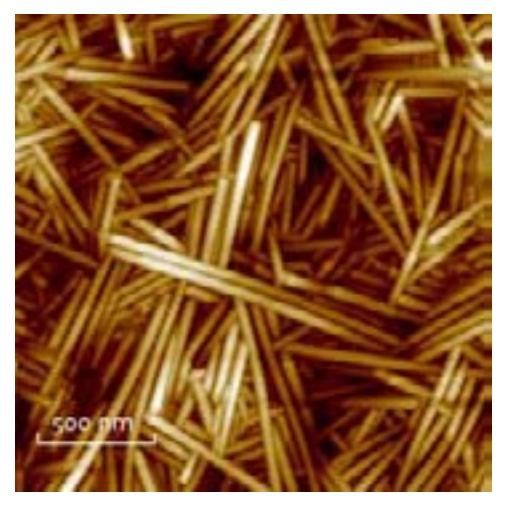
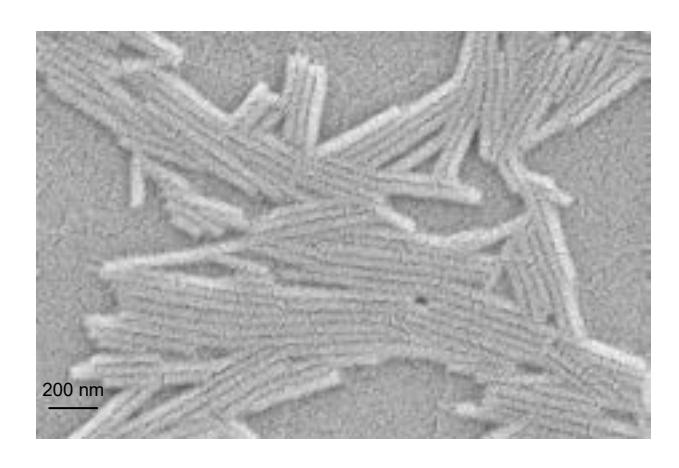
The aim of the research is to use the self-assembled thin polymer films and apply block copolymer arranging techniques to assemble thin crystals, in this case the 9ZBL nanotubes. Thin block copolymer films may constitute a template[2] for arranging the applied layer of LC. Highly ordered block copolymer films transferred into inorganic matrices to provide grphoepitaxialy driven self-assembly of LC. We performed multiple method of directed self-assembly of BCP, including laser zone annealing technique[3]. The polymer used (P2VP) can be transferred either into Al2O3 or Pt nanowires.
A similar effect is possible to obtain through arranging methods for thin block copolymers, e.g. shearing force method. We used poly(sodium 4-styrenesulfonate) films on silica wafer with thin layer of 9ZBL to receive parallel nanotubes. Then we put on it polydimethylsiloxane layer, which was shifted at a constant speed under constant pressure above the temperature of crystallization.
We verified the efficiency of experiments using atomic force microscopy AFM and scanning election microscope SEM. Also, we tried to observe mechanism of folding liquid crystalline nanotubes using AFM in the solvent flow.
I should like to present the efficiency of the applied techniques with regard to LC nanotubes organisation.