
In 2017 warm season eastern part of Baltic Sea region got huge precipitation amount. It was calculated that Lithuania in June-October got 50% more precipitation than normal. In some Lithuania parts there were 2-3 times more monthly precipitation than usual. Long term precipitation in many Lithuanian municipalities has caused high damage to crops, and some of the crops have not been harvested. Autumn sowing was heavily aggravated by soaked soil and low air temperatures [1]. Because of this situation about 22% of agriculture harvest was lost and about 88% of winter agricultural plants were not seeded, so farmers have lost over 246 million of euros income.
The goal of this research – to estimate the soil moisture and precipitation patterns in the eastern part of Baltic Sea region ($53-60^{\circ}N$ and $20-30^{\circ}E$) covering warm season (May–October) of the 2017.
Remote sensing soil moisture data were derived from Copernicus Sentinel SWI (Soil Water Index, %) product which was created from METOP/ASCAT sensor with 0.1° spatial and daily temporal resolution. It was also used daily precipitation amount from E-OBS database with 25 km spatial resolution. It was calculated daily SWI anomalies from 2007–2016 average and clustered using k-means method to separate spatial differences of anomalies.
Analyzed Sentinel SWI showed, that start of June SWI was normal (almost no anomalies comparing with 2007–2016 period). After heavy rainfalls (not shown) soil moisture anomaly increased. All the season soil moisture was higher than usual and soil moisture anomalies variation were determined by long term high precipitation amount.
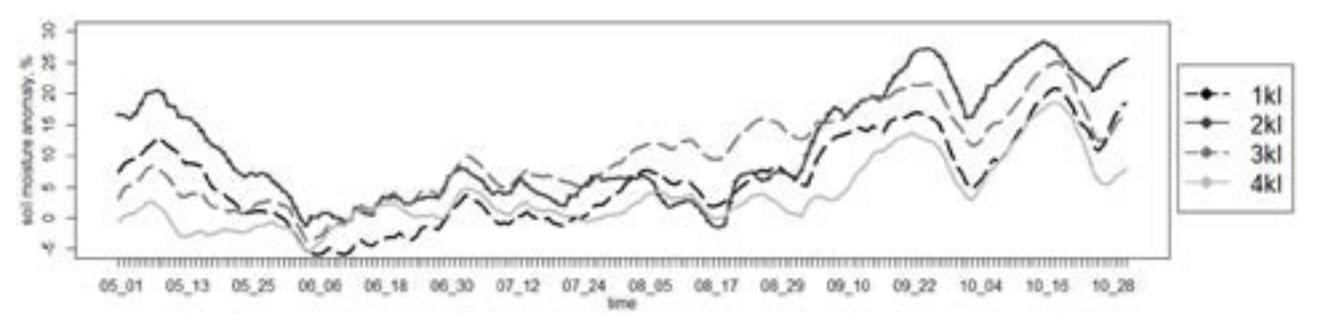
In September 23–October 2 there was almost no precipitation, that leads soil moisture anomaly decreasing (Fig. 1). After this period smaller amounts of precipitation than previously leads increasing soil moisture anomaly at the same level than before non-rainy period. It is believed that this anomaly increase determined of less precipitation is related with soil saturation by water.
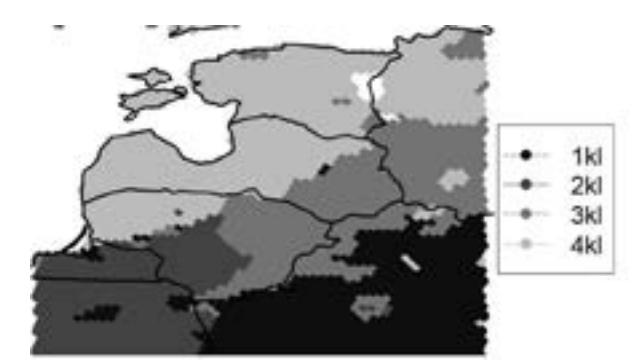
Almost all territory got more precipitation than usual, but highest soil moisture anomalies were in eastern Latvia and eastern—southwestern Lithuania parts (2th and 3th clusters in Fig. 1 and Fig. 2). Not all territories react to precipitation amount at the same way. It mostly depends on land use, soil type and texture, so further analysis is needed.
On climate change precipitation amount and distribution in time and space is changing. Mostly soil moisture studies are focused on drought analysis. But heavy and long-term rainfalls periods are also important. Especially, if it is not usual events. Remote sensing information allows to analyze spatial distribution on droughts and floods to appreciate damage on spatial and temporal scales.