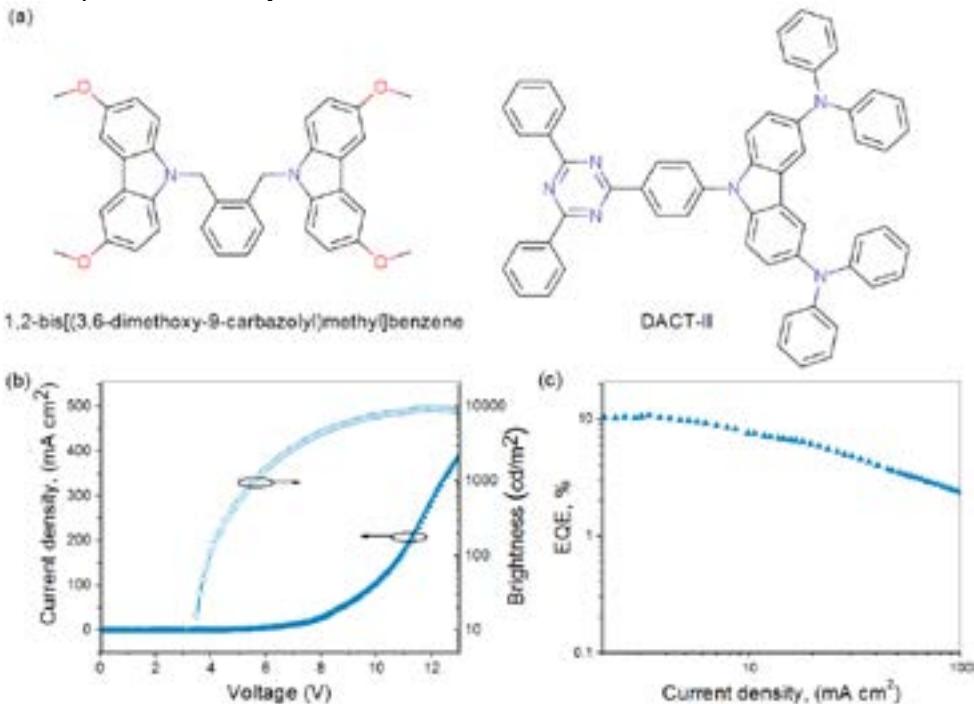
Through the last two decades, much effort has been concentrated on the development of organic light-emitting devices (OLEDs) based on heavy metal organic complexes which produce both singlet and triplet excitons and allow to attain high quantum efficiencies [1]. However, heavy metal-based phosphorescent dyes are expensive and environmentally non-friendly materials which make them less attractive for wide applications. In recent years, a possibility to fabricate highly-efficient OLEDs employing thermally-activated delayed fluorescence (TADF) emitters was demonstrated by Adachi et al. [2]. Since both singlet and triplet excitons take part in generation of light in such devices, host materials possessing high singlet and triplet (at least 2.8 eV) levels are required in order to efficiently produce blue light. Triplet energy levels of electronically isolated carbazole fragments are known to be as high as 3.0 eV. Therefore we have designed and synthesized molecules comprised of carbazole moieties attached to the benzene core through methylene spacers in order to block ${\pi}$-electron conjugation between them and thus to preserve high triplet energy levels.
Four new methoxy-substituted (carbazolylmethyl)benzene compounds were designed and successfully prepared by a simple one-step nucleophilic substitution reaction of 3,6-dimethoxy-9H-carbazole and respective (halomethyl)benzenes. Photophysical, thermal and electrochemical properties of the materials were investigated. They show high triplet energy of 2.81 eV, glass-transition temperatures up to 99 °C and reversible electrochemical oxidation. The device obtained from 1,2-bis[(3,6-dimethoxy-9-carbazolyl)methyl]benzene doped with green DACT-II emitter and displayed high external quantum efficiency of 11.6%.