
During the past several years perovskite solar cell (PSC) technology has evolved from a scientific curiosity to a major research subject in the field of photovoltaics. In that short period of time they have gained recognition as one of the most promising photovoltaic technologies and managed to demonstrate remarkable achievements in the power conversion efficiency (PCE) exceeding 20% [1]. These results have been obtained by using 2,2′,7,7′-tetrakis(N,N-di-p-methoxy-phenylamine)-9-9′-spirobifluorene (Spiro-OMeTAD) as hole transporting material (HTM). However, it is not only quite expensive but also shows unsatisfactory long-term stability due to oxidative doping process and slow morphological degradation. In addition, it cannot effectively protect the underlying perovskite layer from the moisture penetration [2]. Formation of the cross-linkable HTM layers by a spin-coating process may serve as a promising concept to avoid several issues, associated with the use of the Spiro-OMETAD.
In this work, fluorene-based enamines functionalized with two vinylbenzyl ether groups, named HTM1 and HTM2, are presented as the building block for the cross-linkable hole transporting layers (Figure 1). Synthesis of the investigated materials was performed by a simple two-step synthetic procedure from commercially available 2-aminofluorene and 2,7-diaminofluorene providing target products in high yield. The isolated materials demonstrate good thermal stability: the 5% weight loss temperature ($T_{dec}$) of 382 °C is observed for compound HTM1 and 393 °C for HTM2.
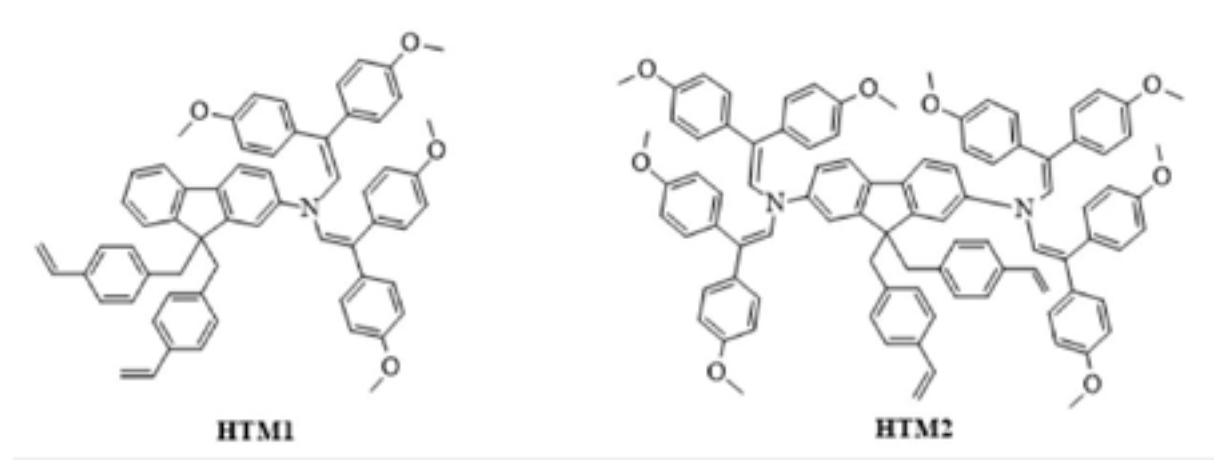
To investigate photoelectrical properties of synthesized HTMs hole drift mobility and ionization potential were measured. Photoelectron spectroscopy in air method was used to measure ionization energy ($I_p$). HTM1 demonstrates higher ionization energy (5.26 eV). Additional electron donating enamine groups (HTM2) lower $I_p$ by 0.15 eV. $I_p$ of both compounds is suitable for the application in the PSCs. Charge transport properties of the investigated HTMs were measured using xerographic time-of-flight technique. HTM1 has demonstrated comparable hole mobility with Spiro-OMeTAD, while HTM2 showed significantly higher hole drift mobility (10-3 cm2/Vs) at strong electric fields.
The cross-linking of HTM2 was investigated using differential scanning calorimetry analysis (DSC). The first heating curve shows the cross-linking process starting at 190 °C and ending at 239 °C. There are no transitions observed during the cooling or second heating cycle of HTM2, from which it can be concluded that the cross-linking reaction was complete during the first heating cycle. However, the thermal cross-linking condition for vinyl groups requires a relatively high temperature, which already exceeds the temperature limit that perovskite can tolerate [2]. In order to lower the cross-linking temperature an aliphatic cross-linker containing four thiol groups, pentaerythritol tetrakis(3-mercaptopropionate) (PETMP), was used. DSC was employed to study the cross-linking between HTM2 and PETMP. The cross-linking temperature was observed from 122 to 141 °C during the first scan. These results imply the fast and complete thermal cross-linking occurs due to the facile thiol-ene reaction.
Thus, synthesized fluorene-based HTMs have potential to become useful materials for protecting the effective underlying perovskite layer in the PSCs.