
Herein, we investigated transient cavitation activity alteration in aqueous suspensions of Mg particles. The increase in the cavitation intensity can be attributed to the formation of small bubbles. The following decrease can be related with the formation of big bubbles by the coalescence of the small ones or the diffusion of the hydrogen gas that is produced during the chemical reaction of magnesium with water (Fig. 1a).
In the case of suspensions with lower concentration of Mg particles after the decrease of cavitation activity the plateau value was observed. This can be explained by the equilibrium of the formation rates of small and big bubbles. In the case of higher concentrations the cycles of enhancement/reduction in the cavitation activity were observed. Hydrogen gas – one of the products of the chemical reaction between water and magnesium – influences the formation and collapse of the cavitation bubbles. Various amounts of the released hydrogen can affect the cavitation intensity in a different way. The schematic illustration of the bubble evolution is presented in Fig. 1b. The initial bubbles of small size can grow as the result of the coalescence or rectified diffusion leading to the formation of the active size bubbles that can further either collapse and produce local areas of non-equilibrium conditions or the bigger ones that can diffuse into air [1]. The cycles of the decrease in cavitation activity can describe the process of the fragmentation of the big bubbles into the smaller ones. Due to a high diffusivity hydrogen can influence the bubble size by the possible diffusion of gas molecules into the bubbles, leading to their enlargement and the growth of the partial pressure of the gas inside the bubble making it more difficult to be collapsed by the external pressure [2].
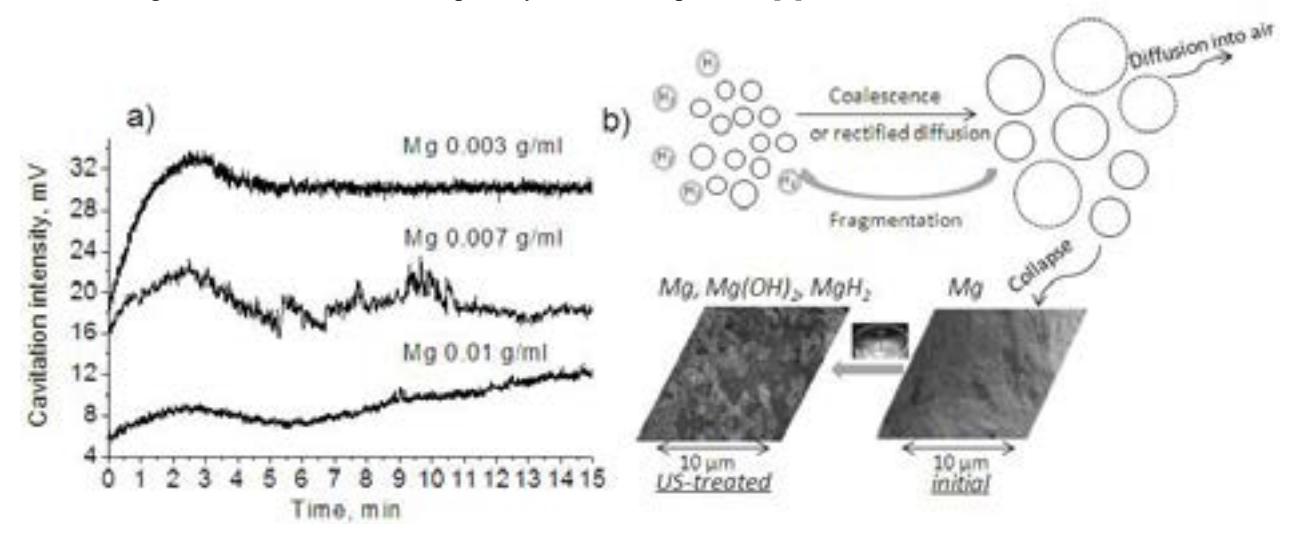
The sonochemically treated particles are characterized by the production of porous structure on the surface of the particles and the presence of the new phases – Mg(OH)2 (brucite) and MgH2 which resulted from both chemical impact of water and released hydrogen and sonomechanical impact of the collapsed bubbles near the metal surface.