Organic-inorganic perovskites recently emerged as a promising class of materials for low-cost photovoltaic technology. A major breakthrough in the efficiency of small area solar cells has been achieved within less than a decade [1]. However, commercialization of perovskite solar cells faces many challenges, including poor long-term stability and scaling-up of manufacturing. Therefore, perovskite materials require thorough scientific investigation and research.
The main goal of this work was to study MAPbI3, CS0.15FA0.85PbI2.7Br0.3 and CS0.05(MA0.15FA0.85)0.95PbI2.55Br0.45 layers using light-induced transient grating (LITG) technique. Carrier transport was analyzed in samples of different chemical composition by determining diffusion and recombination coefficients.
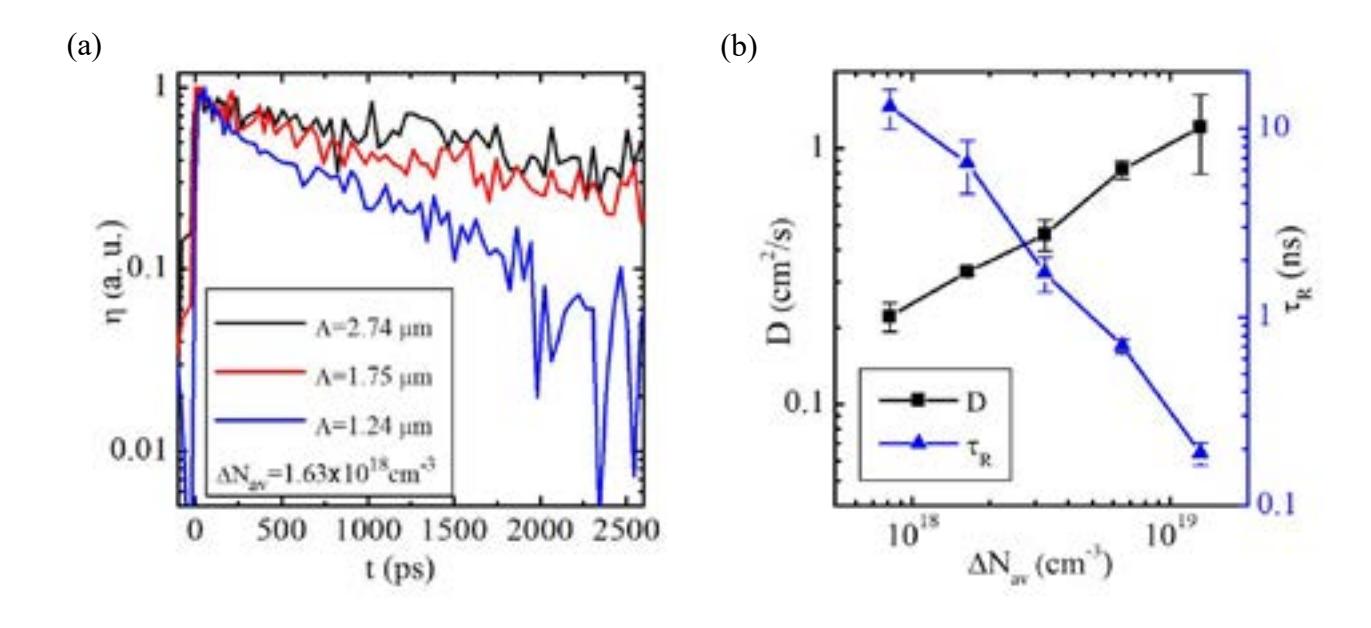
The samples were excited by the laser pulses at 527 nm. For probing, the pulses at 1053 nm with variable time delay were used. Optical attenuator was employed to change the excitation energy fluence, allowing to analyze photoelectric properties of perovskite samples within the wide range of excess carrier density (1017 – 1019 cm-3). Diffraction efficiency $\eta$ transients at different grating periods (Fig. 1 (a)) provided the carrier lifetime $\tau_R$ and diffusion coefficient D and their dependencies on excess carrier density $\Delta N_{av}$.
The measured diffusion coefficient increased with the excitation (Fig. 1 (b)), which was attributed to either carrier delocalization, when the relatively smaller part of carriers remains localized as carrier density increases, or carrier plasma degeneracy [2]. On the other hand, carrier lifetimes reduced with the increasing excess carrier density (Fig. 1 (b)) due to Auger recombination, which was determined from the slope of this dependence. Using the determined values of carrier diffusion coefficient and lifetime, the diffusion length was calculated and yielded the values decreasing with excitation from 0.54 μm to 0.18 μm. Furthermore, comparing the diffusion lengths with thickness of perovskite layers allowed to conclude that the studied perovskite materials were suitable for producing solar cells because values of diffusion length were comparable to active perovskite layer thickness. Finally, the coefficients of radiative recombination and Auger recombination were calculated and compared to those reported in literature [3].