
Pulsed electric field (PEF) technology is abiotic treatment usually used for permeabilization of various cells and tissues. Nowadays it is attracting attention as a non-thermal pasteurization method for liquid foods [1]. It is known that PEF is not only capable to induce permeabilization of yeast plasma membrane but also to trigger programmed cell death mechanism [2]. The mechanism by which microorganisms are killed is not validated yet.
High survival rate after PEF is very important for introducing biomolecules into the cell. One of the key components used for detoxification of reactive oxygen species in cells is glutathione system. Our goal was to reduce PEF induced stress response and increase viability of microorganisms by supplementing cells with antioxidants.
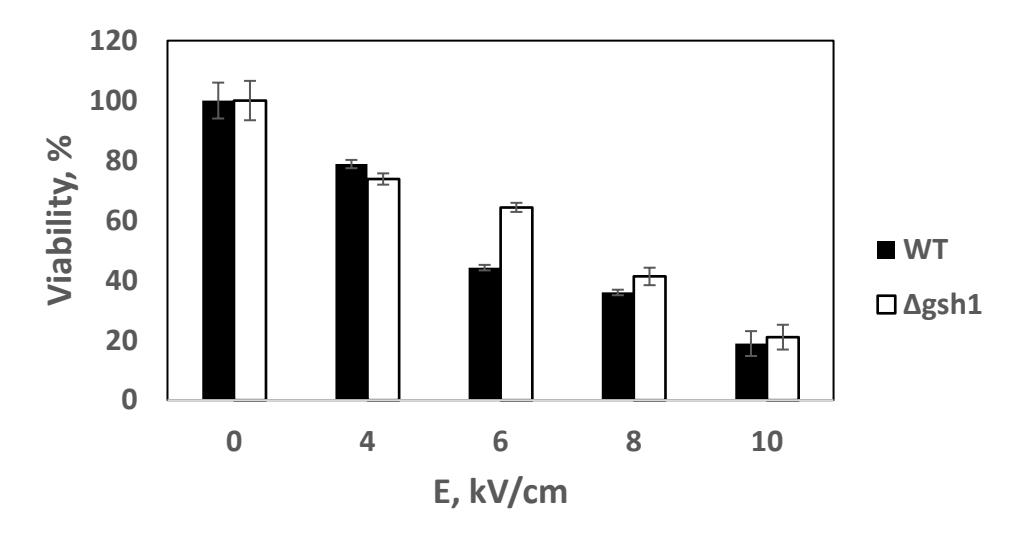
First of all, we evaluated effects to yeast cells viability using different electric field strength (E = 4, 5, 6, 8, 10 kV/cm) at the same 150 $\mu$s pulse duration. WT (Y10000) and $\Delta$gsh1 yeast cell lineages where examined. No significant differences in viability between cells from different strains was observed. Such effects were caused by cultivation in full growth medium which provides glutathione externally. For further experiments we chose 5 kV/cm electric field strength which decreases yeast cell viability by 50% (Fig. 1).
We further investigated glutathione effects on yeast viability by adding it into solid growth media. Optimal glutathione concentration was 1 mM. WT yeast cells viability was not significant dependent to glutathione concentration. However $\Delta$gsh1 cells were more sensitive to external glutathione concentration fluctuations. This cell lineage showed increasing number of colony forming units as the glutathione concentration in solid medium increased. Moreover $\Delta$gsh1 cells formed colonies of different sizes. Number of small colonies decreased with raise in glutathione concentration. Decrease in colony size was compensated by adding 5 mM of glutathione in solid media. Worth to mention that smaller colonies did not showed respiratory deficient petite phenotype. This suggests that colony size dependence to GSH concentration in solid medium is unannotated phenomenon for $\Delta$gsh1 cells lineage.
Furthermore, we conducted experiments which investigated glutathione effects on PEF treated WT yeast cells. Yeast cells where incubated with various concentrations of glutathione before PEF treatment. Also, WT yeast cells were plated on solid minimal medium with different glutathione concentrations. Incubation of WT yeast cells in mediums with glutathione before and after treatment provide no significant effects suggesting that this strain can produce enough of glutathione itself.
We conclude that the viability of yeast decrease with raise in pulsed electric field strength. The roles of antioxidants such as glutathione and vitamin E during exposure to PEF treatment and recovery of cells remain to be investigated.