
One of the most serious worldwide problems is counterfeiting. The forgery of currency, goods or important documents is a huge problem for everyone, including government bodies and big companies. The modern achievements in science and technology create new ways to overcome this serious problem [1]. One of many techniques is security printing.
Luminescence materials emitting in the visible range upon ultraviolet light excitation are used for security printing, holograms, luminescence markers and security labels. All of anti-counterfeiting techniques have advantages and limitations. From this point of view, luminescent materials improved security pigments industry due to their unique optical properties. Usually lanthanides-rich materials are used as luminescent pigments in the security printing. Among them, europium ions doped phosphors have received the great attention, because of strong visible light emission.
In this work, Rb2Bi(PO4)(MoO4):Eu3+ and K2Bi(PO4)(MoO4):Sm3+ were investigated as the potential phosphors for luminescent security pigments. These materials showed good color saturation, high luminous efficacies, and good quantum efficiencies.
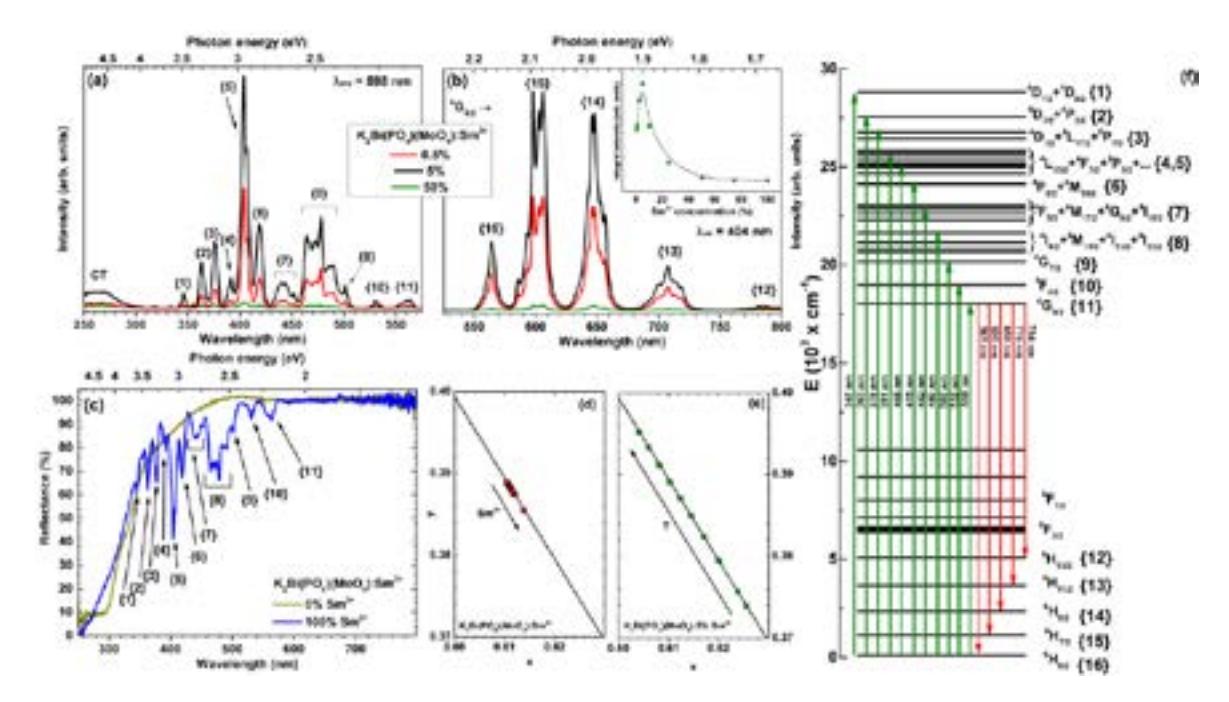
Rare earth doped materials have received a huge attention for security applications because of characteristic sharp emission lines due to the intraconfigurational f-f transitions (see Fig. 1f). These materials also demonstrate long lifetimes, excellent thermal stability, high quantum yields, etc.
The structural, morphological and optical characteristics of the synthesized compounds were investigated by powder X-ray diffraction (XRD), scanning electron microscopy (SEM) analysis and UV-Visible spectroscopy. The reflection, excitation and emission spectra of the single phase compounds were measured and analyzed. The temperature dependent emission spectra and decay curves in 77 – 500 K temperature interval were also recorded and will be discussed.
Moreover, color points, luminous efficacies (LE) and photoluminescence (PL) lifetime values were also calculated. Eu3+ doped samples were red emitting and showed quantum efficiencies close to unity, whereas their Sm3+ counterparts possessed ca. 55% efficiency. Differences between synthesized series as a function of Eu3+ or Sm3+ concentration will be presented and discussed.