Lithium-vanadium fluorophosphate (so-called tavorite LiVPO4F) is a cathode material for Li-ion batteries. Due to a high voltage value close to 4.2 V, it can be used in electric cars and other high-power mobile devices. On the other hand, its theoretical gravimetric capacity is modest and close to 156 mAh/g [1].
One of the possibilities to improve this value is the exchange of the heavy phosphate group to other lighter anionic group. In this work, the PO43- group was exchanged by the BO33-, leading to synthesis of nominal composition LiVBO3F. The material was obtained in a glassy form using melt-quenching method. After the melting, the glass was subjected to thermal nanocrystallization in order to obtain highly-conductive nanocomposite material.
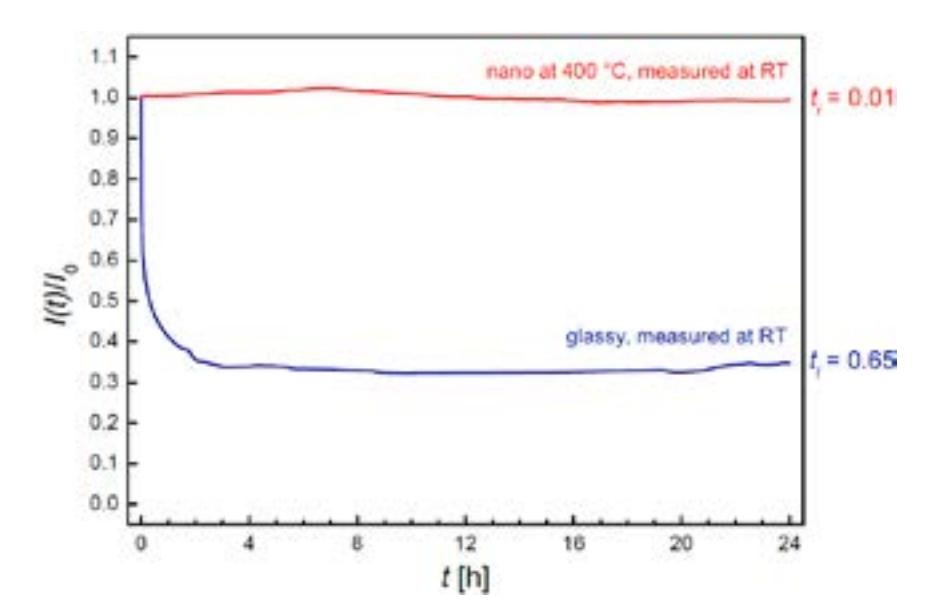
The initial material was amorphous, which was confirmed by XRD method. Also, in the DTA thermograms, a glass transition and a few crystallization peaks were visible. After nanocrystallization, the electrochemically active LiV2O5 and LiVO3 phases were present, with some addition of B2O3 phase. Nanocrystallization also led to improvement of electrical properties – in case of the glass, the total conductivity in RT (room temperature) was equal to $5 \cdot 10^{-9}$ S/cm, while after nanocrystallization in 400 °C and cooling down to RT – $1.2 \cdot 10^{-3}$ S/cm. The results of transference numbers measurement are also encouraging – in case of the glass, the ionic transference number $t_i$ was equal to 0.65, while for nanocomposite $t_i \approx 0.01$ (Fig. 1).