Organic materials exhibiting thermally activated delayed fluorescence (TADF) have attracted much attention due to their enhanced efficiency in organic light emitting diodes (OLEDs) which is possible due to harvesting triplet excitons. TADF occurs due to reverse intersystem crossing. It is possible when the energy difference between excited singlet (S1) and triplet (T1) energy levels is very low [1].
External quantum effiencies (EQEs) of TADF OLEDs have been rapidly boosting in past few years [2]. So far, considerable progress has been achieved in EQEs of blue and green TADF OLEDs. In contrast, the development of high-efficiency orange-to-red TADF OLEDs with electroluminescence peak wavelength longer than 580 nm remains far behind. Up to now, there are only few reports of relatively efficient orange-red TADF emitters [3]. For example, Orange-red TADF emitter, based on triphenylamine units and heptazine core enabled to achieve EQE of 17.5% with an emission peak of 610 nm [4]. However, the highest EQEs of orange-red TADF OLEDs are significantly less compared to those of blue and green TADF OLEDs. Consequently, new efficient orange-red TADF emitters are highly demanded to fill in the gap. The slow development of efficient orange-to-red TADF emitters is associated with numerous strict molecular design considerations and corresponding difficulties. Naphthalimide acceptor-donor molecular design is suitable for development of orange-red TADF emitters.
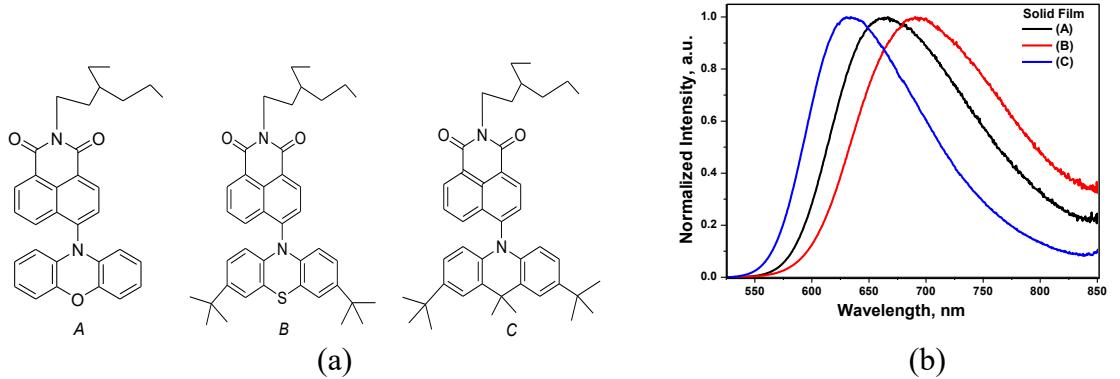
In this work we synthesized bipolar compounds containing 1,8-naphthalimide fragments linked to donor moieties such as phenoxazine, phenothiazine and acridine. The glass transition temperatures of synthesized compounds observed in the range of 51-94°C. The optical and photoelectrical properties of the synthesized materials were also investigated. Emission maxima of solid films of naphthalimide-based compounds observed in the range of 632-693 nm (Fig. 1).