
Since the first Optical Parametrical Chirped Pulse Amplifier (OPCPA) [1] was demonstrated in 1992, many different architectures of high-intensity OPCPA systems have been developed. Supercontinuum generation (SC) in the wavelength range from ~ 500 nm to ~ 1000 nm with picosecond pump pulses [2] simplifies the OPCPA architecture [3] due to the inherent signal and pump synchronization. The temporal shape of the pump pulse determines the spectral bandwidth of amplified pulses. We demonstrate a compact TW-class VIS-IR wavelength range NOPCPA with an almost lossless spectral bandwidth due to the formation of "M"-shaped ps pumping pulses after the SHG-conversion. Moreover, the reuse of depleted pulses after the 1st SHG stage increases the overall efficiency.
Compressed pulses with an energy up to 21 mJ, pulse width of 1.15 ps and excellent beam quality $M^2 \sim 1.1$ at a wavelength of 1030 nm were obtained from a two-cascaded double-pass CPA-compressor based on Yb:YAG rods [3]. A small fraction of this output was used to generate SC in a 15 mm YAG rod. Under optimal excitation conditions, the stability of SC pulse energy and beam pointing in the wavelength range from 600 to 1000 nm is several times greater than the source stability [4]. The second harmonic was generated in two successive cascades based on LBO and BBO crystals with a conversion of 62% and 70% respectively (Fig. 1, left), their overall efficiency reached 90%. The picosecond "M"-shaped pulses (Fig 1,right - left inset) were formed after the 1st SHG cascade due to the strong depletion of fundamental radiation.
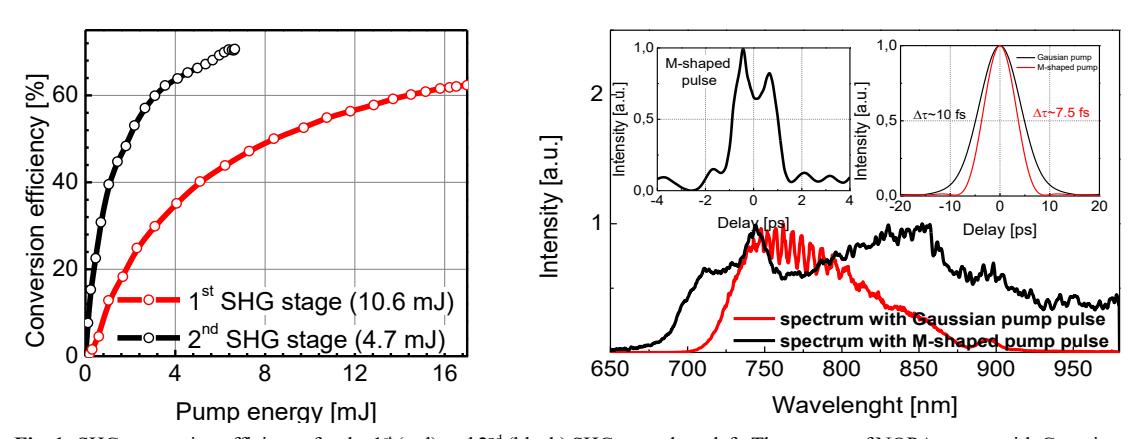
The M-shaped ps pulses were used to pump the first two NOPA stages based on BBO crystals. A significantly wider spectral bandwidth (Fig. 1, right) is achieved, while the energy recycling after SHG stage also increases the overall NOPCPA conversion efficiency. The output energy after the first two NOPA stages exceeds 0.2 mJ. Our calculations demonstrate a significant decrease in the output pulse width (Fig. 1, right – right inset) from 10 fs (black) to 7.5 fs (red) due to the "M"-shaping of picosecond pump pulses.