
Focus on the new materials used in the packaging of foodstuffs and their coverage of the surface processes research. Some nanoparticles such as titanium dioxide (TiO2) and zinc oxide (ZnO) nanoparticles are nontoxic. The photocatalytic reaction of TiO2 nanoparticles has been to inactivate a wide spectrum of microorganisms [1].
The aim of this work is to cover the surface of the polyethylene (PE) films with nanoparticles of zinc oxide and titanium dioxide and to investigate their antimicrobial properties. The antimicrobial agents such as the TiO2 or ZnO nanoparticles-coated PE films also help extend the shelf life of foods by extending the lag period of microorganisms [2].
The polyethylene films were coated with synthetic and commercial zinc oxide (ZnO) and titanium dioxide (TiO2) nanoparticles. Antibacterial effects of TiO2 and ZnO nanoparticle-coated PE films on E. coli, B. megaterium, B. sphaericus were investigated. The inhibitory activity of the coated and uncoated PE films was tested under UV (wavelength 365 nm, 6W power) lamp. The growth of cells cultures was monitored every two hours by the optical absorption and was expressed in the cell colony-forming units.
The antimicrobial activity of the ZnO nanoparticle-coated PE films had little influence compared to the control (uncoated PE films). TiO2 nanoparticle-coated PE films were identified to inhibit cell growth (Fig. 1). Depending on the bacteria used, the growth may be as low as 37% (E. coli), 50% (B. sphaericus), 61% (B. megaterium) compared to the control. It is also evident that the use ZnO nanoparticle-coated PE films has resulted in more colony forming units than using TiO2 nanoparticle-coated PE films.
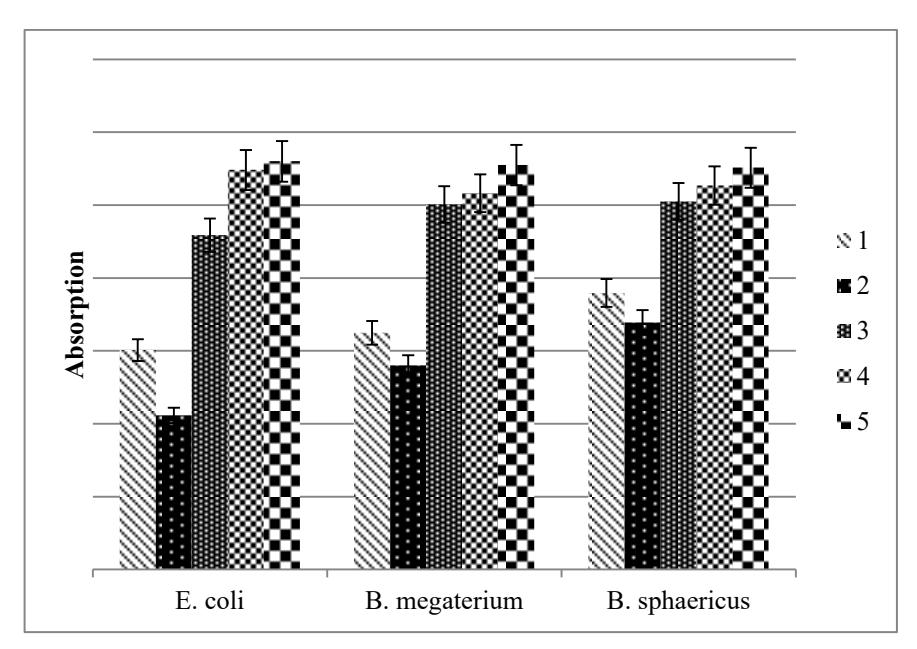
This study demonstrated that both synthetic and commercial TiO2 nanoparticle-coated PE films inhibit cell development by 39-63%. It was also found that PE films coated with titanium dioxide nanoparticles and exposed under UV light reduces the growth of bacteria on foods better than just UV light.