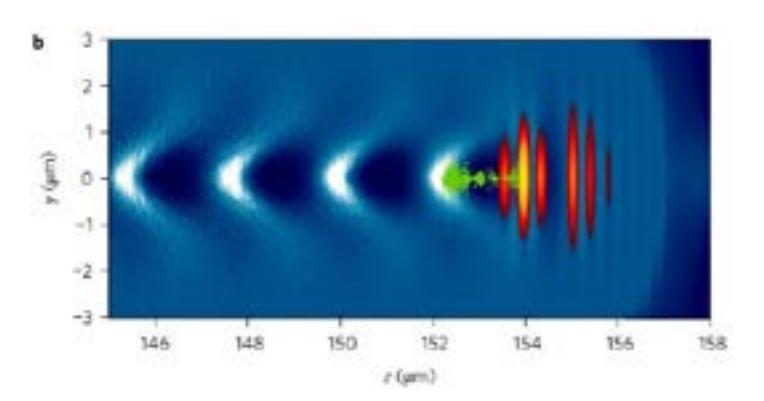
Continuing progress in laser technology has enabled dramatic advances in laser wakefield acceleration (LWFA), an electron acceleration technique that permits accelerating gradients three orders of magnitude higher than conventional radio-frequency methods. Due to significantly reduced space charge and velocity dispersion effects, relativistic electron bunches accelerated by laser wakefields have also been identified as a candidate tool to achieve unprecedented sub-10 fs temporal resolution in ultrafast electron diffraction (UED) experiments [1], [2]. High repetition rate operation is desirable to improve data collection statistics and wash out shot-to-shot charge fluctuations inherent to plasma accelerators. It is well known that high-quality electron beams with narrow energy spreads and small divergences can be achieved in the blowout, or "bubble" regime [3], which is at present regularly accessed with ~30 fs Joule-class lasers that can perform up to few shots per second. Our group on the contrary employed a cutting edge laser system producing few-mJ pulses compressed nearly to a single optical cycle (3.4 fs) [4] to demonstrate for the first time that, consistently with the scaling laws [5], relativistic electron beams with properties characteristic to the blowout regime and peaked at 4-6 MeV energy can also be achieved at kilohertz repetition rate [6]. We further investigate the plasma density profile effects on the accelerated charge and electron energy and show that using certain structured gas jets several tens of pC/shot can be achieved [7]. We expect this technique to lead to a highly accessible and robust instrument for the scientific community to conduct UED experiments or use it for other applications.