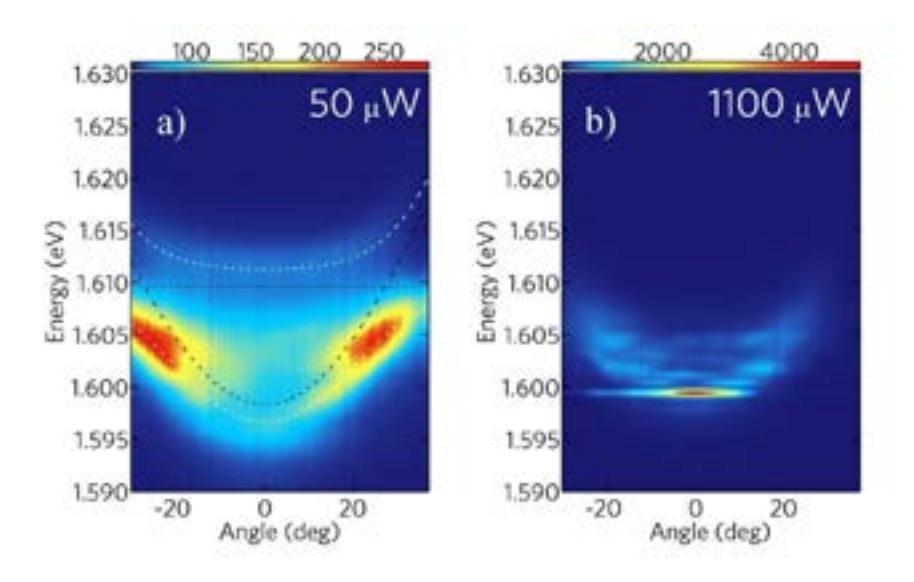
Bose-Einstein condensate (BEC) is an extremely interesting state of matter. BECs occur when atoms or quasi-particles enter same quantum state. There are many types of BECs, depending on what particles are being condensated and by which mechanism they do so. For example, cooling gases to temperature near to absolute zero leads to Bose-Einstein condensation of its atoms. However, condensation occurs also in small mass particles, like exciton-polaritons. Phenomena occuring in cavity exciton-polaritons are relatively new field of scientific research. Exciton-polaritons are quasi-particles, which emerge in strong coupling regime between photons and excitons. Exciton-polariton condensates can be observed in higher – and therefore easier to achieve – temperatures than atomic BECs, that's why there's a significant interest in studying those mixed light-matter quasiparticles in various systems. The most studied structures are semiconductor microcavities, in which cavity photons interact with excitons confined in quantum wells. Microcavity consists of two distributed Bragg reflectors grown using molecular beam epitaxy method. Exciton-polaritons present unique set of properties – bosonic nature and low effective mass in particular – which have enabled to localise them in μm size traps and observe BEC in solid-state system [1].
In this work, we present the formation of exciton-polariton condensates and discuss differences between them and their most remarkable properties in two types of microcavities. We examine microcavities with quantum wells containing magnetic manganese ions [2] as well as analogical but non-magnetic cavities. Detailed description of our microcavities structure will be given. Figure below shows difference between exciton-polaritons before and after condensation threshold. We describe the relation between changes of power of the laser excitation and localised condensates. Finally, we demonstrate an observation of circularly polarized condensates in semimagnetic microcavities and linearly polarized in non-magnetic ones.