
Tin sulfide presents good optical quality, electronic characteristics (band gap varying between 1-2.3 eV in the visible range, high charge carrier mobility and etc.), physicochemical properties [1]. One of the merits of SnS is that it's abundant in nature, cheap and nontroxic [2]. Other merit is that tin sulfide can be adapted to the fabrication of solar cells because of good electronic characteristics.
Thin SnS films can be deposited using a lot of technics, such as chemical bath deposition, spray pyrolysis, electrodeposition and etc [2]. In this work tin sulfide films were fabricated by using SILAR method. The main advantage of SILAR method is that it offers simple fabrication methodology [3]. Thin films can be made almost at standard conditions.
For the fabrication of SnS thin films we used FTO glass. The ultra-sonic cleaning of glass slides was carried out by dipping the glass slide into acetone at 40°C for 10min, then rinsed with distilled water and dried. As the cationic precursor were used 40 °C 0.1M SnCl2 solution and as the anionic precursor -40 °C 0.1 M Na2S The precleaned substrate firstly immersed in the cationic precursor for 30 s and tin ions were adsorbed on the surface of the substrate [4]. Then the glass slide immersed in the anionic precursor solution for 30 s. Sulfide ions reacted with tin ions which were adsorbed on the substrate. Twenty such deposition cycles were repeated in order to get adherent film. For all samples the last step was immersing these in the cationic precursor. The XRD studies on a DRON-6 diffractometer operating with Cu Kα radiation (Ni filter) at 30 kV and 20 mA were performed.
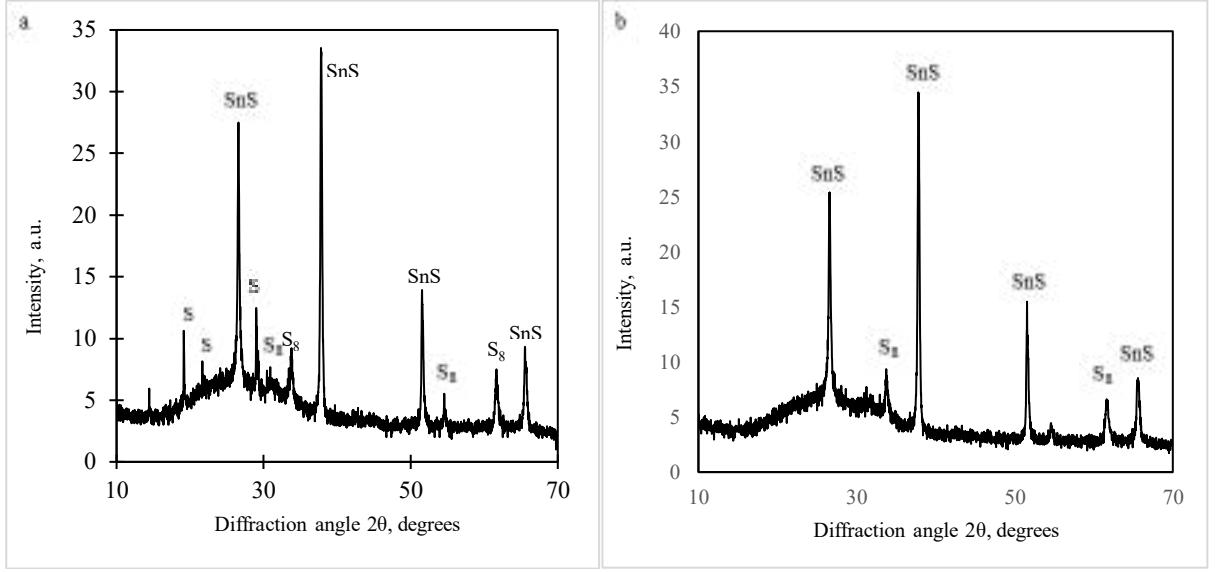
The phase composition of the formed layers was determined by contrasting their X-ray diffraction pattern with those of known minerals. These formed layers consist of SnS (83-47), S (76-183), S8 (74-1465). In both pictures the most intensive peak is assigned to SnS ($2\theta$=37.8°). Other intensive peaks assigned to SnS, at $2\theta$=26.6; 51.6 and 65.6°. The sample was annealed in an inert (nitrogen) atmosphere at 100 °C for 24 h. This process stimulates the formation of tin sulfide. It means that elemental sulfur reacts with adsorbed tin ions to form SnS at higher temperature. SnS peaks are higher than before (Fig. 1 b).