
Since the moment of discovery the effect of surface-enhanced Raman scattering (SERS) in 1974, it has found wide application: in biosensors for detection of different types of cancer as well as Alzheimer's and Parkinson's diseases, for the gas phase detection of chemical warfare agents, in electrochemistry and catalysis, in the detection of single molecules etc [1]. Continuously, investigations are underway to improve the method and search for new directions of its application. The last decade, the attention of researchers is focused on anisotropic nanoparticles. Because of the presence of a second (morphological) localized surface plasmon resonance, that is much more sensitive to the environment, than the usual one, it is possible to increase significantly a detection limit of this method of analysis.
Gold nanorods are one of the most popular types of anisotropic nanoparticles with a well-known and relatively simple method of synthesis [2,3]. Due to the longitudinal (morphological) plasmon resonance that can be tuned in visible and near-IR region of the spectrum by controlling the aspect ratio of nanorods, they are a promising tool for SERS obtaining.
In this work, we compared the efficiency in SERS analysis the gold nanorod and nanospheres substrates at the different wavelength excitations (532 and 785 nm).
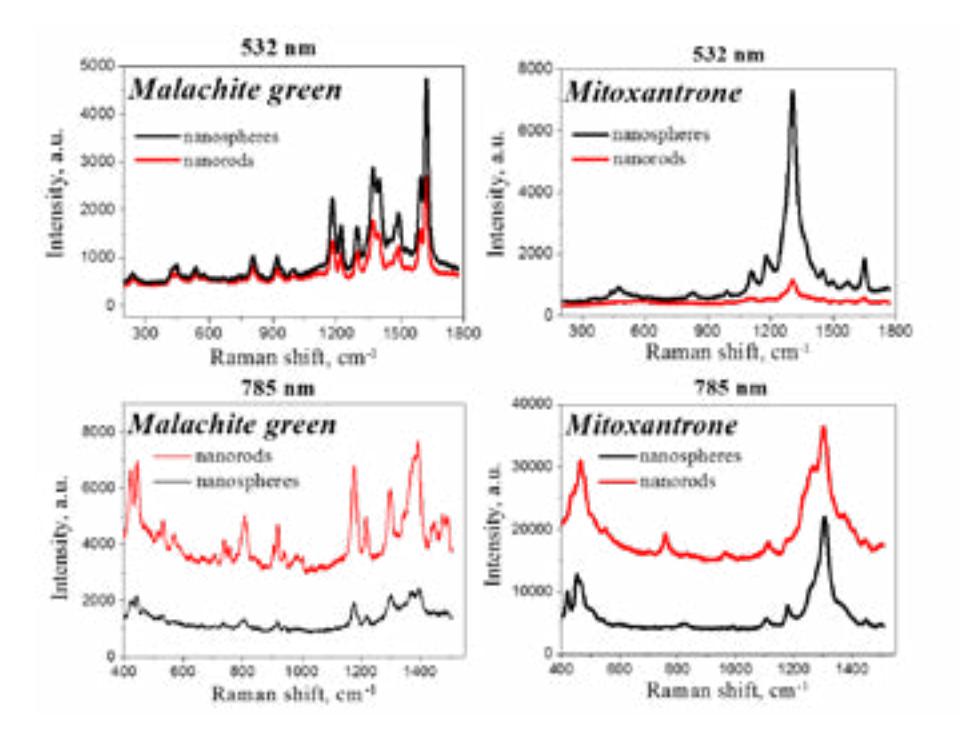
We found that at 532 nm excitation wavelength gold nanospheres are more effective in SERS than gold nanorods. SERS intensity in the case of malachite green was 1.6-1.8 times higher on the nanosphere substrate than on the nanorod one. In the case of mitoxantrone, nanospheres were 6-8 times sensitive than nanorods. The using of more long-wave excitation (785 nm) increases significantly the SERS efficiency of gold nanorods, compared with nanospheres. SERS intensity of malachite green on nanorods was 3-3.5 times stronger than on nanospheres, for mitoxantrone the difference in intensities was nearly 2 times. Thereby, gold nanorod substrates are prospective materials for obtaining strong SERS signals at the excitation in near-IR region, which has some advantages over excitation in visible range like reduced fluorescence and photochemical processes in a sample.