
The iron - platinum system is characterized by high magnetic anisotropy, thanks to which it became the object of special interest of the technology industry as a candidate for applications in the technology of high density magnetic recording media. [1] The high surface activity and strength of Fe-Pt nanoparticles enables their potential applications in the domain of catalysis. [2] The source of these properties is the internal structure of the alloy - the existence of the L10 superstructure from low to moderately high temperatures and the presence of the "order - disorder" transition during which the superstructure is lost to a structurally disordered face centered cubic structure. [3]
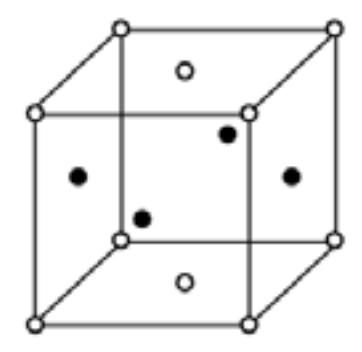
Computer simulations of the atomic ordering process were carried out in the Fe-Pt system using the Monte Carlo method. The applicability of existing pair interaction parameters in this system for its modeling in a wide range of concentration has been verified by determining the order-disorder transition temperatures for three stoichiometric intermetallic compounds: FePt3, FePt and Fe3Pt by simulation in a closed system using the “direct exchange" Monte Carlo algorithm. The obtained results were compared with experimental data. The moment of order – disorder transition was identified on the basis of temperature changes of the long range atomic order parameter. Then simulations of the same alloy were performed in a semi-open system using the SGCMC (Semi-Grand Canonical Monte Carlo) method to determine the stability ranges of the superstructures and to create a partial Fe-Pt equilibrium phase diagram. By determining the equilibrium configurations for systems with different platinum concentration at several given temperatures and calculating the long-range atomic order parameter for them the order – disorder transition temperatures were obtained. The results were consistent with the literature data within the limits of uncertainty of calculation.