
Vertical cavity surface-emitting lasers (VCSEL) provide single-mode operation in threshold. They are very attractive for optoelectronical applications, but they have polarization switching effect (PS) when injection current increase. We can eliminate this effect by changing technological operations, but PS could use in in polarization sensitive applications. Fluctuations lead to polarization switching in polarization instability area. VCSEL have three fluctuation source: the spontaneous emission intensity fluctuations, the current injection density fluctuations and nonequilibrium carriers concentration fluctuations.
In previous research papers [1] it has been shown that the spontaneous emission intensity fluctuations cannot are dominated factor (Fig 1a). The analysis of the statistical modeling results for the VCSELs in polarization instability area has shown that the numerical value of the distribution function dispersion is substantially lower than experimentally observed, especially for the intensity providing the distribution function for the intensity and degree of polarization are qualitatively similar to those observed experimental data.
This work presents the analysis of statistical simulation of output radiation in instability area with current injection density fluctuations and nonequilibrium carriers concentration fluctuations. In works [2] it has been shown that the nonequilibrium carriers concentration fluctuations can be present throw the current injection density fluctuations.
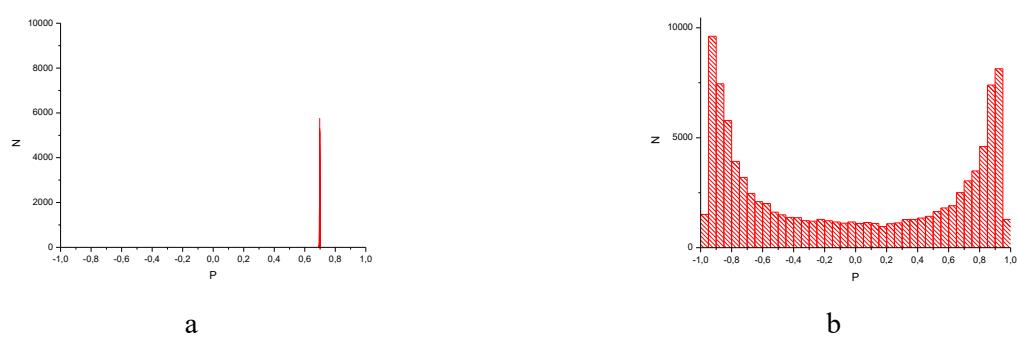
Within the framework of the earlier proposed approach to lasing dynamics inside semiconductor laser cavity the investigations of affect different fluctuation sources on statistical parameters of VCSELs in polarization switching region have been full filled. The numerical simulation results showed that pattern series obtained for the spontaneous emission intensity fluctuations remain constant for the current injection density fluctuations. This suggest radiation formation mechanism of our mathematical model does not contain internal contradictions.
The detailed analysis of the statistical simulations showed increasing gain anisotropy leads to decreasing dispersion of polarization degree and intensity distributions. Increasing spontaneous emission factor leads to increasing dispersion of polarization degree and intensity distributions. All obtained patterns have a transparent and natural interpretation based on our model [3].
The main result of our investigation is the current injection density fluctuations can initiate transitions between states with the values of the polarization degree limited by $(\pm 1)$ (the effects of "mode hopping" or "stochastic resonance") (Fig.2). This effect is known enough in works [2]. Many times the similar results were observed in experimental researches. The current injection density fluctuations and nonequilibrium carriers concentration fluctuations affect gain medium. For multi-passage operation the fluctuations in the concentration of nonequilibrium carriers and injection current are more meaningful than the spontaneous emission intensity fluctuations
Based on obtained results we can assume that the spontaneous emission fluctuations are an important, but not dominated source of fluctuations. However, fluctuations in the concentration of nonequilibrium carriers and injection current are more significant in terms of the statistical parameters formation of the output radiation.