Polyethylene is one of the most widely used plastics for food packaging due to its uncomplicated modification. It exhibits outstanding chemical resistance, high tensile strength and low density. But in order to get the package that we need, additives must be used during manufacturing processes. All these additives can migrate through the functional barrier in to food and contaminate it as the potential migrants might be dangerous chemical substances. All the migrated substances can cause human health problems such as disrupting thyroid systems or allergies [1,2].
The aim of this work was to identify if overall migration of substances from commercially available food packages made from polyethylene occurs. Also, to verify if the migration limits agree with the legislation. According to Commission Regulation (EU) No 10/2011 of 14 January 2011 on plastic materials and articles intended to come into contact with food, plastic materials and articles shall not transfer their constituents to food simulants in quantities exceeding 10 milligrams of total constituents released per dm2 of food contact surface (mg/dm2). What is more, specific migration of barium, cobalt, copper, iron, lithium, manganese and zinc were tested. The results were evaluated according to the same Commission Regulation (EU) No 10/2011 of 14 January 2011, where the limits of metals are 1 mg/kg for barium, 0.05 mg/kg for cobalt, 5 mg/kg for iron, 0.6 mg/kg for lithium and manganese, 25 mg/kg for zinc. In addition, the content of cadmium, chromium, lead and mercury was tested in order to verify if there are any commercially available packages where the content of the metals mentioned exceeds limits according to European Parliament and Council Directive 94/62/EC of 20 December 1994 on packaging and packaging wastes where the sum of concentration levels of cadmium, lead, chromium and mercury present in packaging or packaging components shall not exceed 100 ppm by weight.
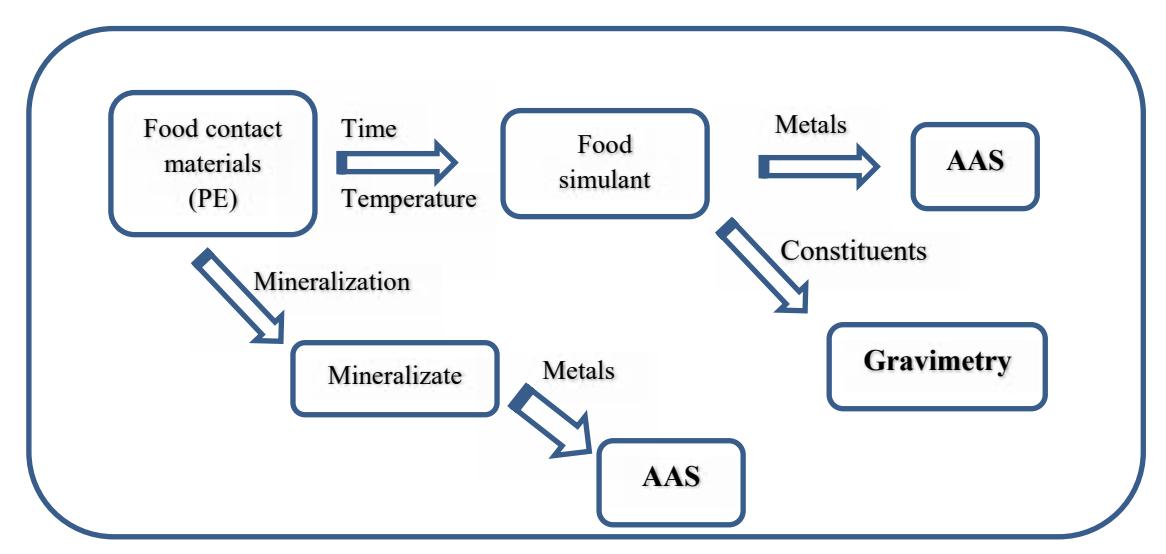
For this reason, overall migration tests were held in different food simulants (ethanol, acetic acid and isooctane) and testing conditions of contact using food simulants which were chosen according to the Commission Regulation (EU) No 10/2011 of 14 January 2011. Furthermore, the determination of metals was carried out by atomic absorption spectrophotometry (AAS). Fig.1 shows the schematic overview of the analytical strategy that was applied. The results revealed the presence of constituents and metals which can migrate to food from polyethylene packaging. The interpretation of the origin of the metals is discussed in the latest work done by the group of scientists who published a huge database called "Chemicals associated with plastic packaging" [3].