The polymerization initiated by light is already successfully used and applied in such areas as laboratories research as well as industry. The main idea of 3D direct laser writing is simple and rapid way to fabricate 3D solid polymeric objects out of liquid prepolymer, consisting monomers, oligomers and photoinitiators. Employing femtosecond laser lithography true 3D, with intricate internal geometry, micro- or nano-scaled structures in high quality can be manufactured [1]. The applications of photopolymerization are shown in such fields as medicine, micro- and fiber optics, photonics, micro-mechanics. [2]
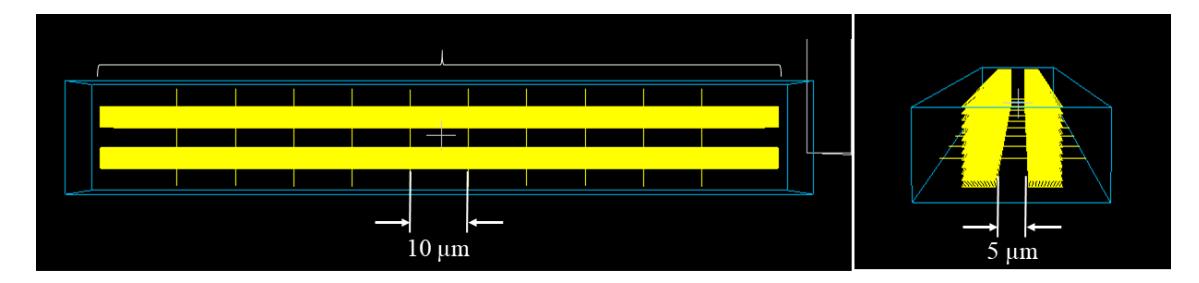
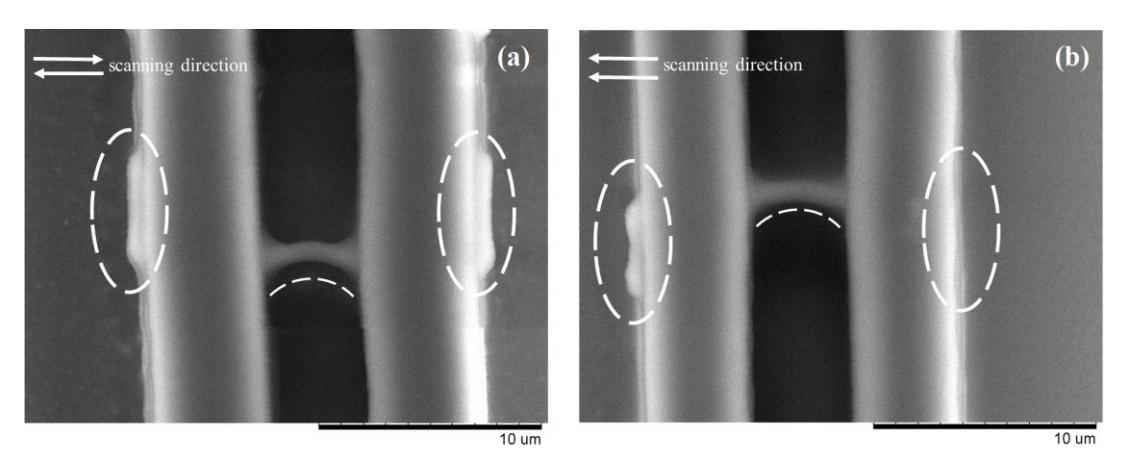
Despite the fact, that 3D laser lithography can be used as a versatile tool, there is a lack of elastomeric photosensitive materials that could be polymerized for specific applications. In this work femtosecond laser lithography experiments were performed with elastomeric resin UV-PDMS (manufacturer ShinEtsu Japan). During the experiments the goal was to determine the optimal parameters for the micro-fabrication of the aforementioned material. The 3D structures shown in the Figure 1 were fabricated with varied parameters and dosages by the change of laser beam average power, scanning (velocity, number and direction). The optimal parameters for achievements of quality results were while using the objective of 63x magnification and 1.4 numerical aperture, the power from 0.4 mW to 0.6 mW and the fabrication velocity up to 3000 μm/s. Also there was noticed, that the scanning in different directions (opposite and the same) results in different symmetry of the fabricated object (Fig. 2). This can be explained by the diffusion of generated radicals and heat [3].
Based on the optimized fabrication parameters, the sample microporous 3D scaffold structures for cell growth will be presented validating the applicability of the chosen material and fabrication technology.