
Recently, various physical methods have become widely used to determine the qualitative and quantitative composition of food and agricultural products. In particular, the method of infrared spectroscopy in the near field of the spectrum is a non-destructive, fast and environmentally safe method of identification of samples. This method allows you to determine the content and concentration of substances, including in foods [1, 2]. Therefore, this work is devoted to the use of infrared reflection spectra for the analysis of some bulk food products.
For experimental research, food samples that used in everyday life were selected: sugar sand, rock salt and baking soda. It was also interesting to study the flower pollen – a complex, concentrated plant-bee product with unique consumer and therapeutic qualities. According to scientific data [3], it has antiphlogistic and antioxidant properties its use does not cause allergic or other side effects.
Measurement of reflection spectra was carried on the analyzer "Infrapid-61" in the wavelength range 1330-2370 nm with a step 10 nm. For this purpose the experimental samples were successively loaded into the cuvette compartment and measured the intensity of the diffuse reflection in the above spectral region. The light flux which diffuse reflected from the object fell on the diffraction grating and then - on the photodetector. The resulting signal was then processed and analyzed using an electronic system. It should be noted that due to weak absorption in the near field and the use of diffuse reflection from the experimental sample, it is possible to direct analysis of the product which excludes complex sample preparation. The reliability of the registration system is quite high and provides a high level of repeatability and accuracy of the result. In this case the recording of the spectrum takes only in a few minutes.
Undertaken studies have shown that the largest number of extremums has a spectrum of sugar sand since it is a complex compound. A simpler view of the spectrum with one obvious extremum has baking soda. The rock salt spectrum is located much higher than other samples (that is the intensity of reflection is greatest). Spectrum of flower pollen is most closely related to sugar sand but its character is clearly different.
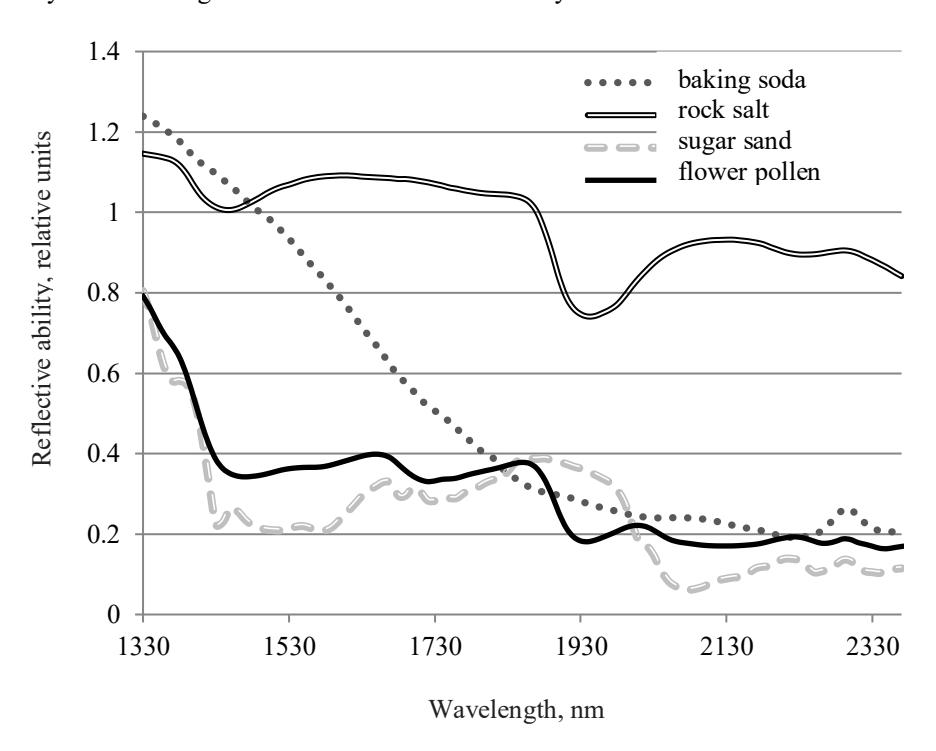
So using the method of near-infrared spectroscopy can identify bulk foods products: baking soda, rock salt, sugar sand and flower pollen. Also by changing the nature and intensity of the corresponding reflection spectra it will be possible in the future to determine the presence in the samples of impurities.