Over the years, Bessel beams gain popularity in laser microprocessing of transparent materials due to unique properties: nondiffractive propagation, extended focus, easy control of beam size, which makes them perfect for applications like high aspect ratio micro void formations [1] and transparent material cutting using induced micro crack propagation techniques [2, 3]. It is noticed, that asymmetric beam profile is the key for crack propagation direction control, which allows ultra-fast glass cutting over non-straight lines [3]. The glass modifications using variations of nondiffracting beams with asymmetric profiles and/or different polarizations are highly investigated to enhance the quality of current process or to find new applications in glass processing industry.
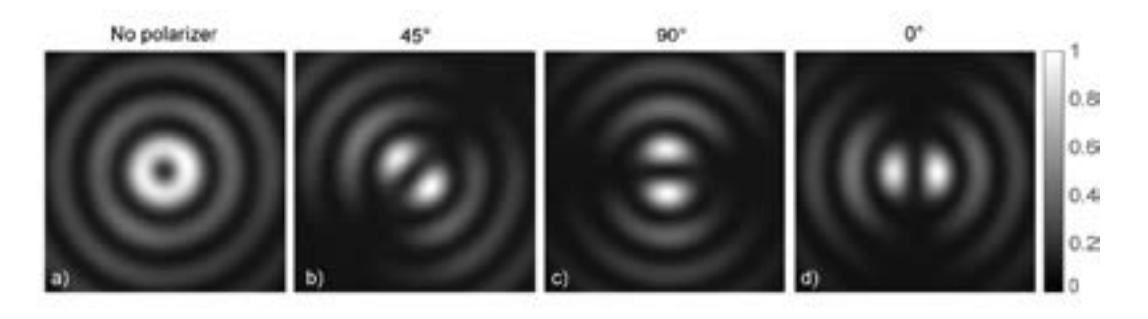
In this work we use an s-plate [4] (Workshop of Photonics) to generate azimuthally or radially polarized beam and with introduction of an axicon we produce vector Bessel beams. These beams are exceptional due to their complex spatial distribution of polarization and symmetric doughnut shaped profile. Polarizer is used to separate single polarization component constituting vector Bessel beam. Intensity distribution of single polarization component shows two peaks that do not diffract over a long distances and the rotation of intensity peaks is dependent on polarizer rotation (Fig. 1). Due to ability of s-plate to withstand high-energy pulses this approach to generate vector Bessel beams is applicable to high-energy beam systems and allows us to investigate volume modification and microcrack formation in various transparent materials.