
Organic light-emitting devices (OLEDs) are an attractive technology for commercial displays and lighting because of their high luminous efficiency, flexibility and adaptability to large areas as well as relatively easy color tuning. Currently, emitters exhibiting thermally activated delayed fluorescence (TADF) properties are considered as the most promising for next generation OLEDs. TADF allows harvesting of non-radiative triplet excitons through their conversion to radiative singlet states via reverse intersystem crossing (RISC) using thermal energy of the environment [1]. It was demonstrated that by careful design and optimization of donor-acceptor based molecular structure conversion, and thus, photoluminescence quantum yield (PLQY) as high as 100% can be achieved at room temperature [2].
In this work a series of new donor-acceptor-donor molecules containing benzoylpyridine acceptor and two carbazole donor moieties were investigated as potential TADF emitters. The studied molecules (see Fig. 1) had different linking positions of the carbazole moieties on a phenyl ring (para and meta linkage) as well as a different location of nitrogen atom in the pyridine moiety (3 and 4 position). Additionally, the impact of solubility-enhancing non-conjugated tert-butyl groups on the photophysical properties of the compounds were studied.
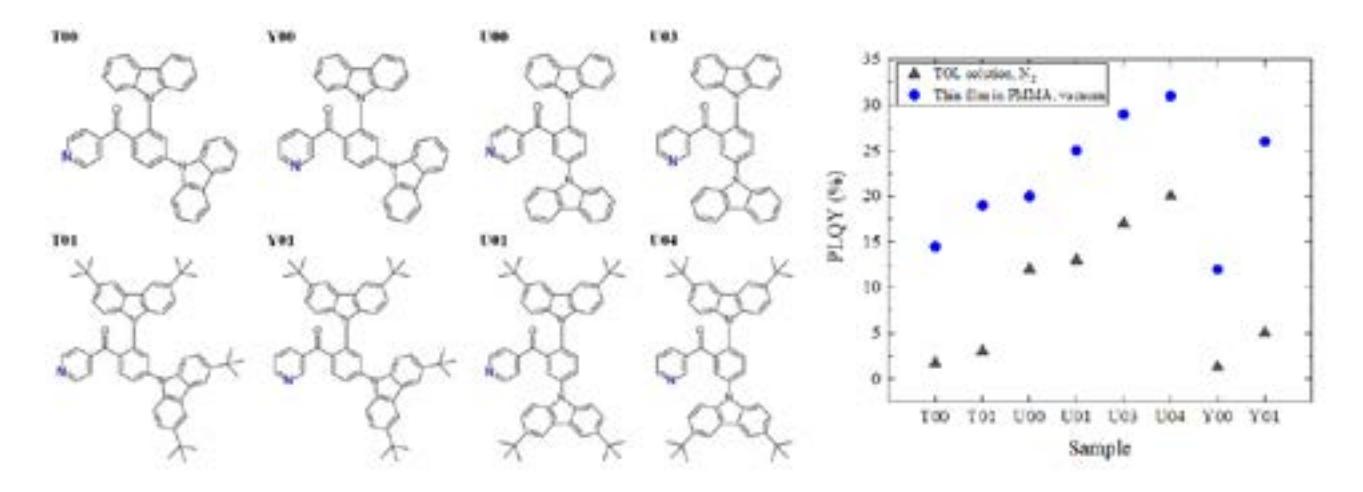
To determine the most efficient benzoylpyridine-based TADF compound for OLED application, absorption, PL, PLQY and PL transients of the compounds were measured in ambient and oxygen-free environments. Good correlation between PLQY values of solution and thin film samples (Fig. 1. right) was found for different emitters. Significantly higher PLQY values for the emitters doped in neutral PMMA films as compared to those of solutions indicated reduced non-radiative decay due to suppressed vibrational/rotational relaxation. Compounds possessing para- linked donors exhibited higher PLQY yet smaller delayed to prompt emission ratio as compared to their meta-substituted counterparts. Moreover, PLQY was found to be higher for compounds with a nitrogen atom in the 3rd position of the pyridine moiety as well as for compounds containing peripheral tert-butyl groups. The obtained results suggest that the compound U04 is the most promising option for fabrication of vacuum- and solution-processed TADF OLEDs.