
The knowledge available on the structure-charge transport relationship acquired during the last decades on conducting polymers (CP) for organic electronics, constitutes a strong basis for the development of polymer-based thermoelectrics[1]. Conductive materials have a huge potecial as electroactive storage materials based on their $\pi$-conjugated structure, tunable condutivity properties and inexpensive manufacturing techniques, since CP can be processed from solutions at low temperatures. Polypyrrole is one of the most researched conductive polymers owing to its inherent properties such as good conductivity, environmental stability, redox properties and biocompatability. The investigations of PPy textile composites as possible fabric energy storage materials[2] has only started and requires a systematic understanding of the influence of morphology, chemical and electronic structure on all principal thermoelectric parameters. The aim of this study was to examine and characterize doped PPy textile fabric composites as thermoelectric materials.
5 different dopants were chosen for PPy composite modification: sodium dodecyl sulfate (SDS), sodium polystyrene sulfonate (PSSNa), sodium dodecylbenzene sulfonate (DBSNa), dioctyl sodium sulfosuccinate (DOSS) and 3% multi walled carbon nanotubes (MWCNT). Doped PPy composites formation were achieved by patented in situ polymerization process on woven wool as dielectric substrate. Woven wool/PPy/dopant composites were synthesized in variation of dopant injection a) in adhesive polyvinyl alcohol (PVA) and FeCl3 matrix, or b) in aqueous monomer pyrrole solution. PVA matrix were transferred via screen printing with particular 20 x 30 cm square pattern. Coated specimens were dried at 100 °C for 5 to 10 minutes, spray-coated with aqueous monomer solution and after quick polymerization reaction dried again respectively.
Thermoelectric sample analysis performed using infrared thermography (IRT), by thermal imaging in an anechoic chamber at ambient temperatures. Doped woven wool/PPy composites were radiated with electromagnetic wave source of 4 GHz. Thermal imaging resuls were collected during heating for 60s every 5s and cooling for 100s every 10s. Surface conductivity and shielding effectiveness measurements were carried out in an anechoic chamber in 1-20 freguency range. Composites morphology was analyzed using scanning electron microscope.
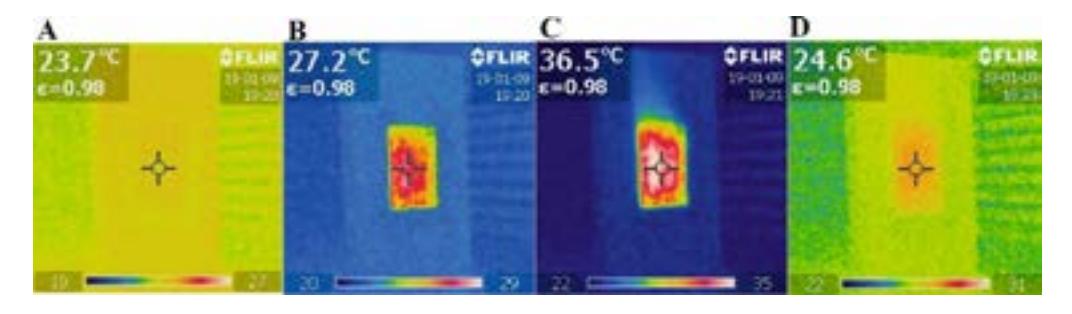
Experimental investigation of IRT led to conclutions that conductive polymer distribution throughout all active composite surface was homogeneous. Termoelectric analysis showed a tendency of temperature dependence from particular dopant with respect to higher dopant concentrations. To conclude doped PPy textiles using in situ polymerization process could be potentially used as a frame material for energy-storing device fabrication.