IMPROVEMENT OF ELECTRON TRANSFER IN MICROBIAL FUEL CELL USING TWO REDOX MEDIATORS BASED SYSTEM
Juste Rozene1, Inga Morkvenaite-Vilkonciene1, 2, Antanas Zinovicius3, Vytautas Zutautas1, Vytautas Bucinskas1, Arunas Ramanavicius3
1 Department of Mechatronics, Robotics and Digital Manufacturing, Faculty of Mechanics, Vilnius Gediminas Technical University, J. Basanaviciaus g. 28, LT-03224 Vilnius, Lithuania
2 Department of Electrochemical Materials Science, State Research Institute Centre for Physical Sciences and Technology, Sauletekio g. 3, Vilnius, Lithuania
3 Department of Physical Chemistry, Faculty of Chemistry and Geosciences, Vilnius University, Naugarduko 24, Vilnius, Lithuania
While every year the global energy demand is growing and the consequences are visible, an alternative, which is less wasteful and cleaner [1] is essential. A fuel cell is an electrochemical device that continuously converts chemical energy to electrical energy for as long as fuel and oxidant are supplied to it. Biological fuel cells operate under mild reaction conditions, namely ambient operating temperature and pressure [1]. Biological fuel cells convert the chemical energy of carbohydrates, such as sugars and alcohols, directly into electric energy. Enzymatic biofuel cells (EFC) and Microbial Biofuel Cells (MFC) recently emerge as very attractive sources of electrical energy that can convert chemical energy into electrical one and to generate electricity even from diluted solutions of biofuels [2].
Several different microorganisms, such as Actinobacillus succinogenes, Escherichia coli and Gluconobacter oxydans could be used as the catalyst in MFCs. In this research, baker's yeast (Saccharomyces cerevisiae) [3] is used because the yeast is a nonpathogenic, inexpensive, easy mass cultivation and easy to prepare. Also, yeasts can be maintained for a long time in the dried state and the relatively high power can be generated in the system.
We designed MFC, in which the yeast cells were immobilized on the anode and used as a biocatalyst. A two-redox mediator-based system was applied, one of them was menadione (vitamin K3), and another one – potassium ferricyanide ($K_3[Fe(CN)_6]$). Menadione is known as the compound, which is able to penetrate the cell wall, while the potassium ferricyanide transfer electrons to the electrode.
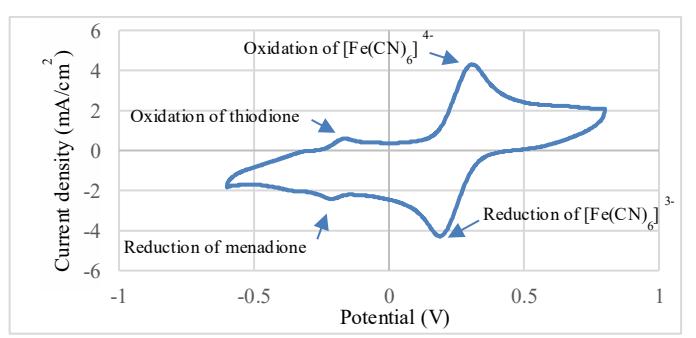
Experiments were performed in three-electrode based electrochemical cell, were graphite electrode (Ø3mm) with immobilized yeasts was connected as working electrode, a platinum electrode as a counter electrode, and Ag/AgCl as a reference electrode. We measured cyclic voltammetry with different concentrations of glucose and mediators (Fig. 1). It was found that the highest MFC-generated current density is 4.2 mA/cm2.
Fig. 1. The cyclic voltamperogram measured with a carbon electrode modified by yeast in phosphate-acetate buffer solution with 4.21 mM potassium ferricyanide, 80.5 mM glucose and 512 μM menadione. Scan rate 0.1 V/s and the potential range from -0.6 V to 0.6 V. Reduction and oxidation peaks of menadione appears at -0.2 V and -0.16 V; oxidation and reduction peaks of K3[Fe(CN)6] appears at 0.2 V and 0.3 V, respectively.
In further researches, the MFC efficiency will be improved by applying different mediators and determining the generated power using several different loads.
Acknowledgments: This research was funded by the European Social Fund according to the activity “Development of Competences of Scientists, other Researchers and Students through Practical Research Activities” of Measure No. 09.3.3-LMT-K-712. Project No 09.3.3-LMT-K-712-02-0137.
[1] A. K. Shukla, P. Suresh, S. Berchmans, A.Rajendran, Biological fuel cells and their applications, Curr. Sci87.4, 455-468 (2004).
[2] A. Kisieliute, A. Popov, R. M. Apetrei, G. Cârâc, I. Morkvenaite-Vilkonciene, A. Ramanaviciene, A. Ramanavicius, Towards microbial biofuel cells: Improvement of charge transfer by self-modification of microoganisms with conducting polymer-Polypyrrole. Chemical Engineering Journal, 356, 1014-1021 (2019).
[3] A. Ramanavicius, I. Morkvenaite-Vilkonciene, A. Kisieliute, J. Petroniene, A. Ramanaviciene, Scanning electrochemical microscopy based evaluation of influence of pH on bioelectrochemical activity of yeast cells—Saccharomyces cerevisiae. Colloids and Surfaces B: Biointerfaces, 149, 1-6. (2017).
[4] C. M. Martinez, L. H. Alvarez, Application of redox mediators in bioelectrochemical systems. Biotechnology advances, (2018).