
Because of environmental regulations against high amounts of lead used in piezoelectric materials (RoHS directive in EU) there have been made a lot of studies trying to find the best lead-free alternatives. Morphotropic phase boundary (MPB) compositions in Na0.5Bi0.5TiO3-BaTiO3 (NBT-BT) offers high electromechanical strain [1]. In this work NaNbO3 (NN) was used as a secondary material for 0.8NBT-0.2BT ceramic. This material changes dielectric spectrum and phase of ceramic. There have not been many publications about this composition except for M. Dunce et al. [2] and Y. Wu et al. [3] studies but they were investigating MPB composition of NBT-BT with NN impurities.
In this work five different concentrations were investigated: x = 0, 0.04, 0.05, 0.06 and 0.08. Dielectric properties were measured at a temperature range 250 K - 500 K on cooling with a rate of 1 K/min. Piezoelectric properties were measured using commercial aixaCCT TF 2000 analyzer.
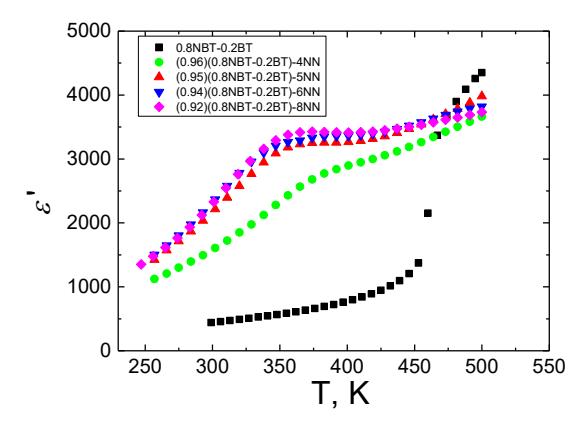
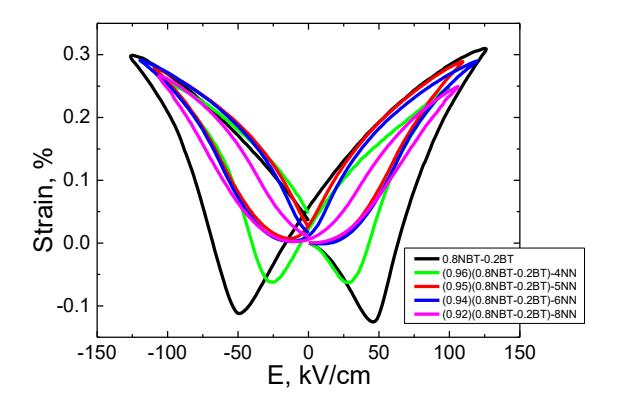
Fig. 1 shows temperature dependence of dielectric permittivity of all tested concentrations at 0.5 kHz frequency. Concentrations containing NaNbO3 have dielectric anomaly occurring at a temperature interval 330 K – 370 K and there is no sign of phase transition which is monitored in 0.8NBT-0.2BT ceramic. Fig. 2 shows electromechanical properties of all tested compositions at a room temperature. Electromechanical stress in x = 0 and 0.04 concentrations are caused because of piezoelectricity and stress in x = 0.05, 0.06 and 0.08 concentrations occur because of antiferroelectricity.