
Electromagnetic radiation sources for wide spectral ranges, from microwave and THz to optical and X-ray, are developed and explored very intensely in last decades. This is due to the fact that such sources can be used both for research and practical purposes in many areas, for example in biology and chemistry, non-ionization diagnostic and medicine, ultra-fast communication technology, space research, etc. [1-2]
The development of free electron lasers (FEL) and its different realizations is one of the promising directions for the creation of tunable and high efficiency radiation sources. In particular, a volume FEL (VFEL) was proposed in [3-6], which implements a volume distributed feedback allowing to reduce size of the device and threshold currents necessary to start the generation. In the first experimental prototype of VFEL [7-8], the radiation was generated by an electron beam passing near one diffraction grating (Smith-Purcell radiation), and other diffraction grating with a different period was used to form the distributed feedback.
In this paper, we consider theoretically the spontaneous radiation of a charged particle (electron) moving in a system that is very similar to the VFEL resonator from [7-8] (Fig. 1). Two planar diffraction gratings with different periods are formed by parallel metal wires. A charged particle moving between them can generate Smith-Purcell radiation. It is assumed that particle moves perpendicular to wire axes.
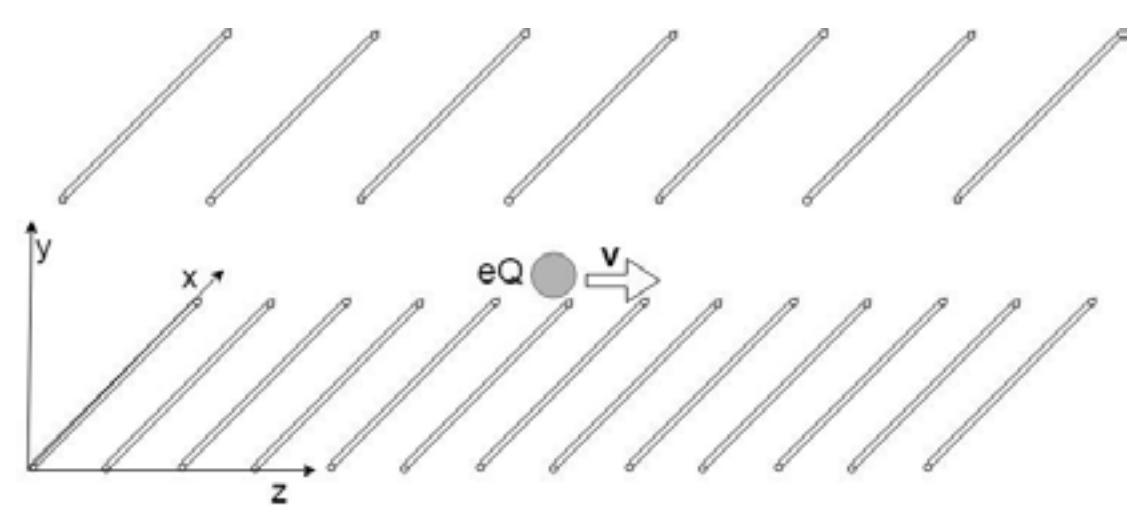
The analytical expression for the spectral-angular distribution of radiation was obtained. It is shown that radiation intensity is sensitive to distance between particle and gratings and decreases exponentially with the growth of it. Also radiation intensity can be changed by parallel relative shift of gratings and by selecting the appropriate shift it can be made several times larger than the corresponding value for one grating.