
Nowadays the highest problem in the world is climate changes. One of the most important challenge is to guaranty that the average global temperature change would not increase by more than 1.5 °C. Therefor we need to find some alternatives to help to stop this process and one of the ways is to use more bio products in everyday using. One of the sectors with the highest pollution and green-house gas emissions is heating and cooling sectors. Lithuania uses quite large amount of biomass for heating, but it is expected that the use of biomass residues could be even more profitable and environmentally friendly. On the other hand, some residues, such as oak sawdust have good heating value, but low stability while pelleted while others are not so good for heating purpose, but have adhesive properties which could improve the quality of pallets. Therefor the mixing of different biomass residues could be one of solutions while looking for materials to increase energy value as well as economic and environmental benefits.
The aim of this study was to evaluate the quality of diffrent organic raw materials - residues from industry processing and their mictures – used bioenergy.
In the present study, 5 organic raw materials (oak sawdust, lignin, potato peelings, linseed cake) and their mixtures were analyzed. This samples were collected from different places after processing. The main parameters describing the quality of biomass are moisture content, ash content, biomass chemical composition, energy value and chemical composition of smoke.
The results of study revealed differences in ash content of organic raw materials mixes (Fig. 1). The Ash content was the highest with oak sawdust 20% and lignin 80% it was 12.2% of the ash then specificity reached 2%. The least ash content was with oak sawdust 80% potatoes waste 20%, oak sawdust 80% linseed oil waste 20% and oak sawdust 80% miscanthus 20%. In other treatments when oak sawdust concentration was the lowest and other materials - the highest ash content was highest too.
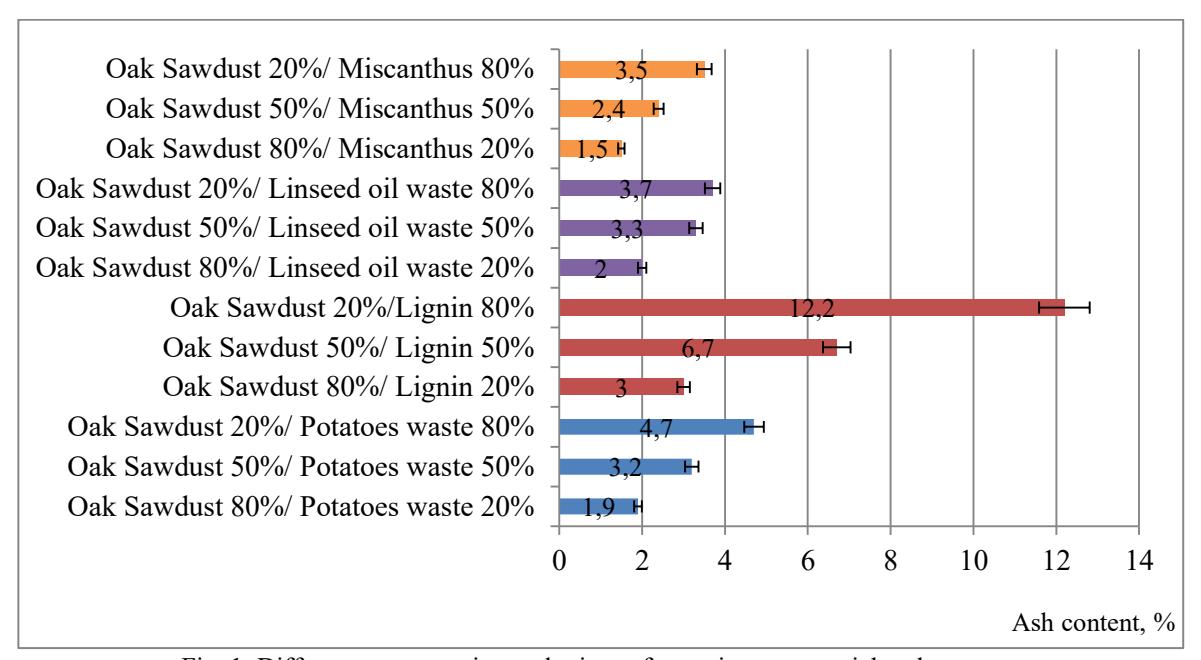
In conclusion this analysis revealed what is the concentration of ash content after burning into organic raw materials. Oak sawdust 80 % and other organic raw materials which is in the specificity stint can to solve a two problems. One is that it is can be new biofuel type. The second one is the help make a pallets from oak sawdust, because now oak sawdust is unstable. The energy value and quality of pallets produced from different biomass source are influenced by biomass quality.