
In order to create water-soluble non-toxic derivatives of the antitumor antibiotic daunomycin (DM), two methods have been developed for the synthesis of organic-inorganic nanocomplexes based on DM, polyvinylpyrrolidone (PVP) and selenium nanoparticles (Se NPs). PVP was used as an "additional” stabilizer, since Se NPs are aggregatively unstable in the presence of only DM [1]. It was previously shown that DM forms complexes with PVP due to hydrophobic interactions of anthraquinone aglycone of daunorubicinone with PVP [2].
The first method of synthesis is concluded in the preliminary stabilization of Se NPs (nanoparticles as a result of the redox reaction between selenous and ascorbic acids) with PVP followed by the addition of DM. The second method is implemented as a result of synthesis of the DM and PVP complex with the subsequent synthesis of NPs as a result of the redox reaction. The hydrodynamic radius (Rh) of the synthesized nanocomplexes were studied using dynamic light scattering.
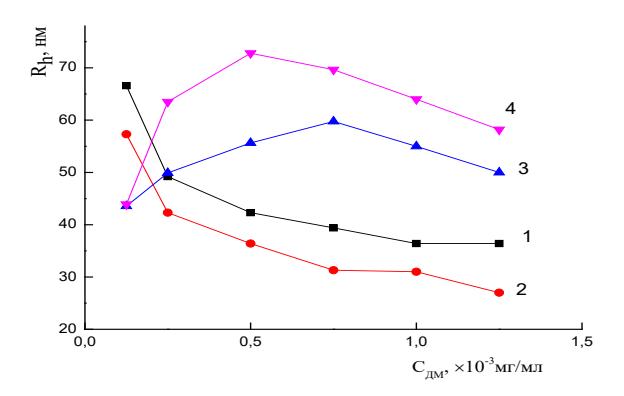
Figure 1 presents data on the effect of the concentration of DM on the Rh values of nanocomplexes with $C_{\text{Se}}$ =0,05 mg/ml and $C_{\text{Se}}$ =0,025 mg/ml, which were synthesized by the described methods. For $C_{\text{Se}}$ =0,05 mg / ml, the value of Rh decreases with increasing $C_{\text{DM}}$, and the radius of the composites obtained by the first method are larger than the second. Probably, in the first case, Se NPs are first stabilized by PVP, and the introduced DM molecule, which is small compared to PVP, is "embedded" in the preformed PVP – Se composite (Rh = 40 nm). This embedding was carried out on the outer layer of the PVP-Se nanocomposite envelope and led to an increase in the Rh of nanoparticles obtained by the first method of synthesis at $C_{\text{Se}}$ =0,05 mg/ml.
For $C_{\text{Se}}$ =0,025 mg/ml, the dependence Rh=f($C_{\text{DM}}$) has a maximum, and the radius of nanocomplexes obtained by the second method are larger than the first. Apparently, this is due to the influence of the concentration ratio of the components. In this case, due to the "reduction" of the Se NPs concentration, the previously formed PVP – DM complex (according to the second synthesis method) is relatively weakly bound to the NPs and the nanocomplex is a “loose" particle with a large size.
The appearance of a maximum in dependencies (curve 3, 4) with increasing DM concentration may be due to a change in the internal structure of a nanocomposite forming in solution: as a result of an increase in DM concentration, after the maximum loose structure is achieved and compaction of the forming nanocomplex begins.
Thus, the method of synthesis and the concentration ratio between PVP and DM determine the morphology and dimensional properties of nanocomplexes.