
The implementation of in vitro technology in large-scale production of walnut seedlings presents superiority. The micropropagation techniques of explants obtained from walnut nodal segments of Chandler variety have advantages in early plant ripening, development of the root system, and compatibility of rootstock and scion in grafted plants [1].
The development of the root system and the acclimatization of walnut explants exhibit complicated behavior during micropropagation. The conventional micropropagation approaches for in vitro rooting of walnut explants is not effective, therefore, the improvement of tissue culture protocols is required. The establishment of new technologies is a key for coming through these issues.
The young walnut stems of 0.5-0.8 cm width with leaf buds of Chandler walnut are cutted and treated with fungicidal solutions (Penconazole and copper oxychloride) for 20 minutes. After, they are washed with distilled water 3 times and dried on filter paper in a laminar flow cabinet. The stems are placed in flasks with water and the flask bottleneck is covered with a transparent plastic film. After bud growth, the leaf explants of a 3 cm length are cut in a laminar flow cabinet, treated with sodium hypochlorite solution for 10 minutes, and washed with distilled water 3 times.
A ready-made nutrient medium DKW [2] was used and solidified with 3.5 g/l phytogel (Gelzan ®). Before sterilization, the pH of the all nutrient solutions were adjusted to 5.9. The media sterilization is hold at a temperature of 121°C and a pressure of 105 kPa for 20 minutes. The leaf buds of Chandler walnut are transferred into DKW multiplication medium with the addition of benzyl aminopurine - BAP (1 mg/l), indole butyric acid - IBA (0.01 mg/l), and phytogel (2.5 g/l). They are kept in growth chambers, programmed to 16 hours light / 8 hours dark photoperiodic and 25°C temperature mode. After 40 days, the explants are transferred to the new nutrient medium.
The modified WPM (Woody Plant Medium) is used for in vitro rooting of Chandler walnut explants. The root system is induced by adding 10 mg/l IBA to nutrient medium and etiolating for a week. The auxin free nutrient medium supplemented with vermiculite is used for subsequent root development in 16 hours light / 8 hours dark photoperiodic condition. The rooted walnut seedlings are washed gently in order to eliminating nutrient medium residues. Subsequently, they are placed into polystyrene trays containing peat and vermiculite, and acclimatized. The high relative humidity is provided during the first week of acclimatization. After the appearance of the new leaves, the humidity is reduced and ventilation is increased. Young seedlings are transferred to nursery after sufficient accumulation of lignin and hardening.
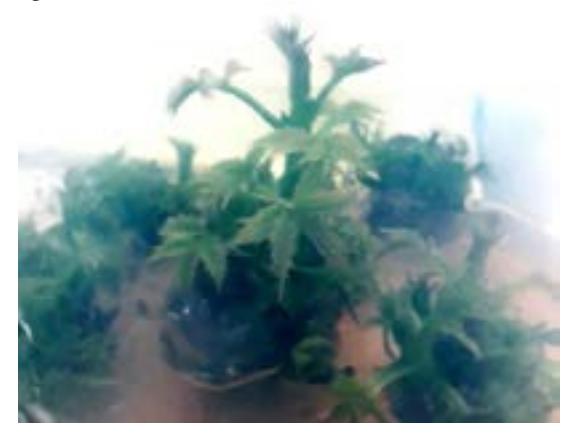
1-5 microshoots are formed from each Chandler walnut explant in DKW fortified with BAP (1 mg / l) and IBA (0.01 mg / l). The mean number of microshoots is 2.38; and the mean length is 3.15 cm. The root system of Chandler walnut explants is induced with etiolating and adding 10 mg/l IBA. Subsequent development of root system is observed in a hormone free modified WPM supplemented with vermiculite. The walnut seedlings successfully acclimatized at high humidity. The improvement of micropropagation techniques of Chandler walnut provides development of plant production for commercial use.