The interest in conducting polymers has proportioned a growing interest on the surface plasmon resonance (SPR) technique due to its high sensitivity, in situ and real time measurements in characterizing films [1]. The combination of SPR with electrochemical measurements (ESPR) has been demonstrated as a powerful technique for the simultaneous characterization and manipulation of electrode/electrolyte interfaces [2].
The surface functionalization by molecular assembling in the applications of organic electronics has attracted enormous interest during the past decades. Self-assembled monolayers (SAMs) are promising approach for the molecular assembling down to nanoscale [3], so it is extremely useful for sensitivity investigation then trying to discover relevant biosensor.
Glyphosate-based formulations (the most common being Roundup or N-(phosphonomethyl)glycine) are the most widely sold and used herbicide globally. They are used on food crops during cultivation, also used in gardens, along roads and railway tracks. After 40 years of ignorance policy on glyphosate's secondary side effects, many studies in recent years have suggested that glyphosate has worrying health effects at levels regularly detected in food and tap water. In order of such global issue many scientists are trying to discover the best analytical solutions and one of the most popular – research of suitable biosensors.
A biosensor is a device that incorporates a biological recognition (sensing) element in close proximity to, or integrated with the signal transducer, to give a reagentless sensing system specific to a target compound (analyte).
Main objectives of this study are to reveal biosensor on the basis of polypyrrole (PPy) which would be sensitive to glyphosate (Glyp) by using ESPR method. In order of that we studied glyphosate adsorption on PPy formed on SPR gold disk and compared it with glyphosate adsorption on polypyrrole thin layer formed on 11-(1H-pyrrol-1-yl)undecane-1-thiol (PUT) monolayer which was assembled on SPR gold disk.
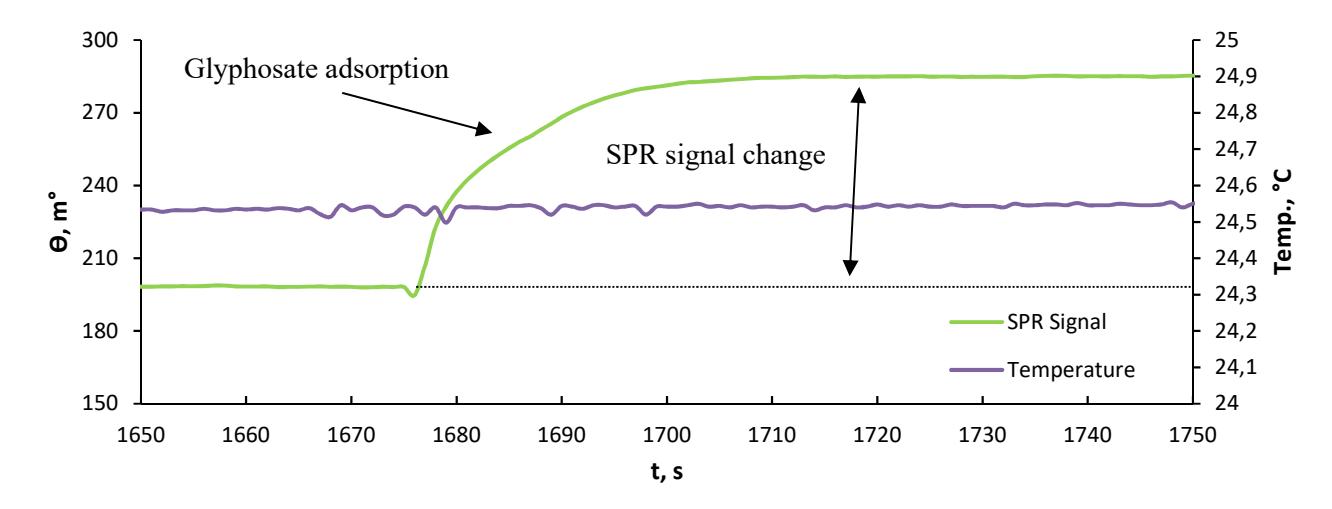
The use of SPR and electrochemical impedance spectroscopy methods revealed that Glyp adsorbs from PBS solutions on PPy coated gold surface (Fig. 1), also as adsorbs on PPy formed on PUT monolayer which was assembled on gold surface. For next step we are going to study Glyp behavior on PPy surface, investigating non-imprinted polymer (NIP) and molecularly imprinted polymer (MIP) PPy sensitivity on Glyp.