
Diamond-like carbon (DLC) thin films are well known of their distinctive mechanical, optical, electrical and chemical properties [1]. Introducing free electron metal nanoparticles into DLC can be used to tailor the properties of films even further and opens up new possibilities in plasmonics. In this work, we investigated nanocomposite DLC films with embedded silver nanoparticles (DLC:Ag), irradiated by femtosecond laser. The analyzed films on the quartz substrate were deposited employing reactive magnetron sputtering of silver target in direct current mode under hydrocarbon atmosphere [2]. It was determined that the silver content in 60 nm thickness film was 12.6 at %.
Spectroscopic ellipsometry (SE) is a powerful optical measurement technique which is used to determine the change in polarized light upon reflection or transmission on a sample. This technique basically measures two parameters: amplitude ratio $\Psi$ and phase difference $\Delta$ between s and p polarized waves [3]. Using these parameters, it is possible to calculate refractive index and the thickness of the film, deeper analysis provides information about surface roughness, etc.
Direct laser interference patterning (DLIP) was employed to impose periodic patterns in DLC:Ag films. A matrix of points varying applied number of pulses (1000-125000 pulses) and laser fluence (1-17 mJ/cm2) was imposed. Total irradiated area was $300 \times 300 \ \mu\text{m}^2$. Data for preparing the SE map was acquired using spectroscopic ellipsometer GES5-E (Semilab). The angle of incidence was 75° and the step along x and y axis was 30 $\mu$m. $\Psi$ parameter map was plotted at the wavelength of 690 nm and $\Delta$ was plotted at the wavelength of 640 nm (Fig. 1 a and b respectively). The wavelengths for different parameters $\Psi$ and $\Delta$ map were chosen with highest differences in parameter values at different areas of the sample (Fig. 1c).
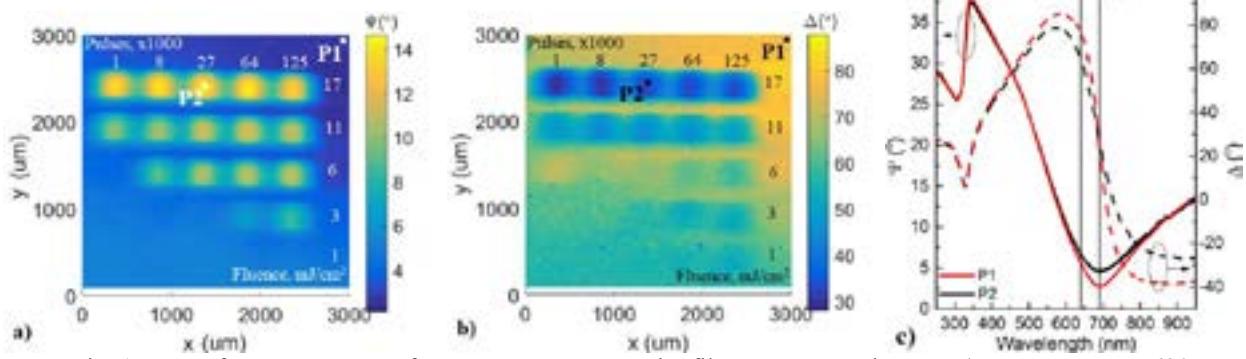
From the obtained SE maps, it is clear that increasing laser fluence provides highest differences in ellipsometric parameters. At fluences 6 mJ/cm2 and lower, number of pulses becomes an important parameter. The further data analysis would lead to thickness decrease and refractive index modifications depending on applied number of pulses and laser fluence.