
Metal nanocrystals have excellent applications in the biomedical, electronic, catalytic, and sensing fields. Silver nanoparticles (AgNPs) have been one of the most important nanostructural materials due to their fascinating properties and potential applications in many fields. Due to extensive research performed in this field, it is well known that the properties of metal nanoparticles are closely related with their size, shape, composition and crystallinity. Therefore, the properties of the AgNPs could be controlled and adjusted by tailoring their particle shape and size [1]. And these can be adjusted by choosing the synthesis method and appropriate precursors. Up to now, AgNPs have been successfully synthesized with a variety of shapes, including spheres, spheroids, disks, rods, wires, stars, prisms, cuboctahedrons, right bipyramids, cubes etc [1].
The polyol synthesis designates the liquid-phase synthesis in high-boiling, multivalent alcohols [2]. The advantages of this synthesis route are the variety of polyols that can be used, good solubility of most metal salts, most polyols become reductive in high temperature, and according to the synthesis conditions one can obtain nanoparticles of different size and shape.
In this research, the polyol process is used for synthesis of silver nanocubes and synthesis kinetics is analysed. The precursor silver nitrate and copper chloride were dissolved in 1,5-pentanediol in a glass vial. In another glas vial polyvinylpyrrolidone was dissolved in 1,5-pentanediol. Two precursor solutions were injected repeatedly in hot reaction flask with 1,5-pentanediol (heated in oil bath) and reaction took for about 12 minutes after which the reaction media became opaque. Final colloidal solution was left to cool down at room temperature. More synthesis details can be found in [3]. Every two minutes the samples from reaction media were taken out to check the kinetics of the reaction. As silver nanostructures have size dependent surface plasmon resonance in visible light region, the UV-VIS spectroscopy (Avantes, measurement range 190 – 1100 nm, resolution 1.4 nm) was employed to check the reaction kinetics. For this purpose, silver colloid was dispersed in ethanol and measured. Corresponding spectra during different periods of reaction is shown in Fig. 1.
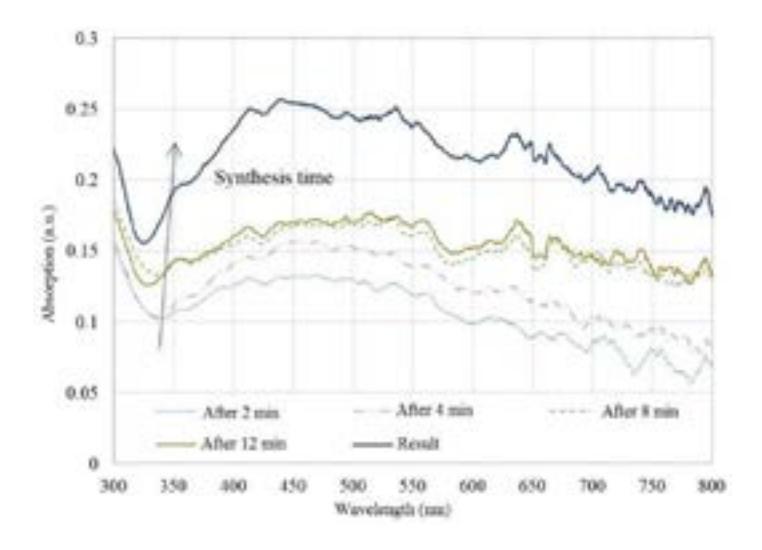
From the UV-VIS absorption spectra it was found that silver nanoparticles of different sizes were formed. It should be emphasized that the small absorption peak at 350 nm is responsible for the one of cube resonance modes (at the edges) [4]. The synthesis kinetics study revealed that the intensity of absorption peak increases with longer synthesis time, which shows that the number of nanoparticles was increasing in the solution but the position of the peak remained the same indicating retained size distribution.