Metal-organic frameworks (MOFs) have emerged in the recent years as promising materials as their properties suggest variety of potential applications in gas adsorption and storage, microreactors, etc.[1] due to their porous structure. Gas adsorption properties of zeolitic imidazolate frameworks (ZIFs) are believed to be tightly related to a flexible nature of organic linkers in these compounds. In this research ZIF-90 compound was studied in different atmospheres: vacuum, N2, CO2 and air, in 150-400K temperature range and 100 Hz – 1 MHz region.
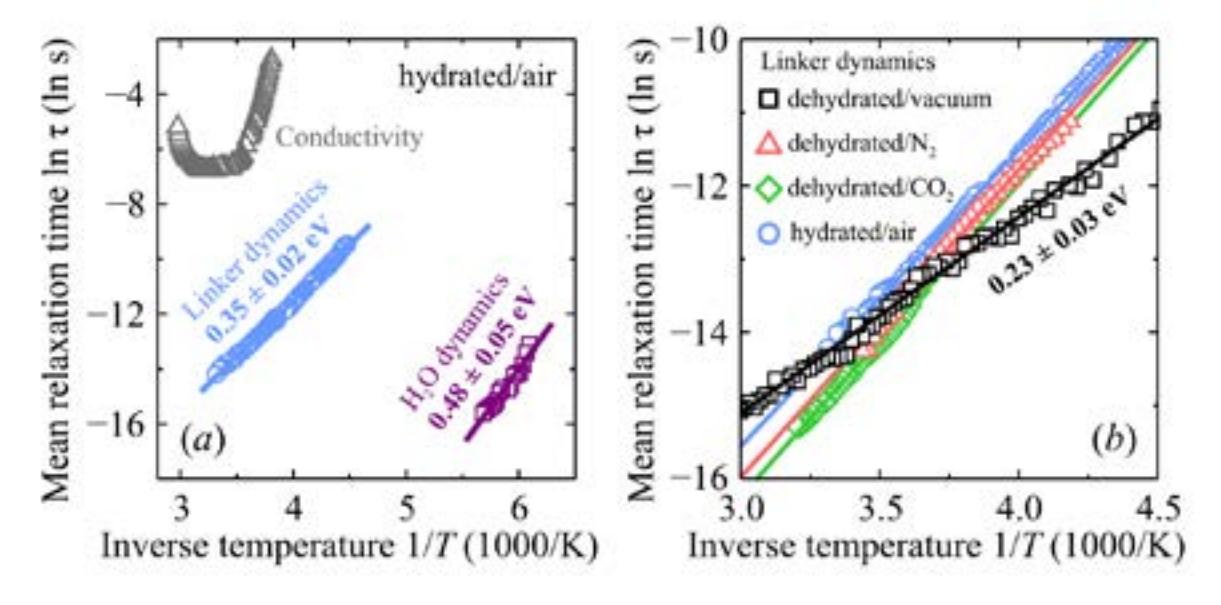
Performed dielectric spectroscopy experiments with dehydrated sample in vacuum, N2 and CO2 conditions compared to the results of hydrated sample studies in air allowed us to reveal the differences in activation energy, that we suppose, is due to the different dynamics of ICA linker. As noted in Fig.1 the activation energy of linker movement in vacuum ($E_a = 0.23 \text{ eV}$) is significantly lower compared to dynamics in gas atmospheres ($E_a = 0.36 \text{ eV}$).
Fig. 1. Inverse temperature dependence of the mean relaxation time of (a) different dipolar processes in hydrated ZIF-90 and (b) linker dynamics for ZIF-90 in different atmospheres. The lines are linear fits indicating Arrhenius processes.
[1] I. Ahmed, S.H. Jhung, Composites of metal–organic frameworks: Preparation and application in adsorption, Mater. Today.17 (2014) 136–146. doi:10.1016/j.mattod.2014.03.002.
[2] Sergejus Balčiūnas, Mantas Šimėnas, Diana Pavlovaitė, Martynas Kinka, Fa-Kuen Shieh, Kevin C.-W Wu, Jūras Banys, and Robertas Grigalaitis, Low-Frequency Dipolar Dynamics and Atmospheric Effects in ZIF-90 Metal-Organic Framework, J. Phys. Chem. C2019123 (1), 631-636.