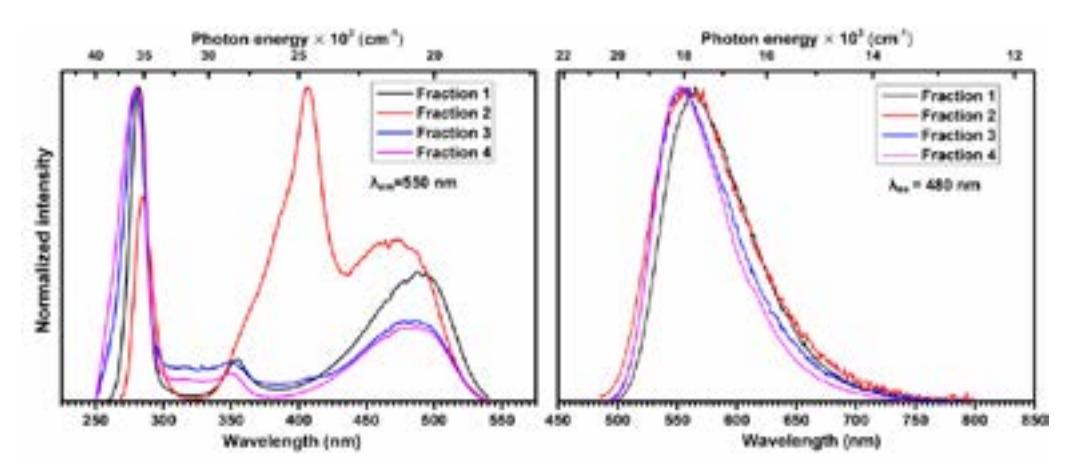
The aim of this scientific work is synthesis and investigation of optical properties of carbon quantum dots (CQDs). Since accidental discovery of these nanomaterials during purification of single walled carbon nanotubes, the attention and interest to them has grown tremendously and keeps attracting many scientists and scientific groups. As a result of many investigation works carried out after their discovery, these formations proved to have unique and exceptionally useful properties that are often found in such nano scale sized materials.
Currently, the main focus concerning CQDs is directed towards the search and development of the most efficient and optimal synthesis methods that could provide their massive scale productions. Such particular attention to CQDs is deserved due to their physicochemical and luminescent properties. Especially worth mentioning are their good water solubility, easy surface modification, chemical inertness and photostability comparing to the traditional semiconductors quantum dots, all of which have a great practical potential. Additionally, such extremely useful and rarely found properties in material sciences as biocompatibility and low toxicity, render their application in white-LED production, bioimaging, biosensors and the field of theranostics that proves itself to be a very valuable and important branch of medicine currently being intensively developed. Nonetheless, important are electronic and photocatalytic properties that carbon quantum dots possess and can find their use in optical devices as well as catalytic systems [1].
As for now, there is no unambiguous model as to what physical processes make photoluminescence mechanism possible in CQDs [2]. However, it is evident, that it can be controlled upon changing size of these nano scale formations and modifying their surface by various organic functional groups or inserting heteroatoms into their structure which can be achieved using different synthesis methods and their variations. The graphitic like structure creates band gap between HOMO (highest occupied molecular orbital) and LUMO (lowest unoccupied molecular orbital) that take part in electron transition process between them and thus causing light emission. This suggested model predicts the energy/wavelength of light emitted upon excitation, i.e. with increasing size of quantum and level of condensation, band gap energy between HOMO and LUMO levels is getting more narrow and thus a red shift in emission spectrum takes place. Analogically, with decreasing size of QDS emission peak moves towards blue part of the visible spectrum.
Currently, the largest issues that have raised from synthesis of these nanomaterials are aggregation of formed CQDs, poor size reproducibility and monodispersity, and unsatisfactory precision in surface modification, all of which have motivated us to the idea of initiation of such project which might at least slightly contribute to the search and development of the most optimal synthesis method of these exceptionally useful nanomaterials. Factors like time, temperature, pH, solvent or presence of different oxidators and reductors during synthesis, that have impact on CQDs formed, will be considered to predict the best possible synthesis conditions.